


motor manufacturing industry: the thinner the motor core material, the better?
The first thing to be clear is that no single material is optimal (or even usable) for every application, and trade-offs must be made between cost, weight, size, and other factors. In addition, the lamination process after fabrication has a large impact on the performance of the designed core. Criteria for material selection include cost, permeability, electromagnetic losses, and saturation flux density. Permeability and core losses vary with flux reversal frequency (in Hertz) and flux density, and in some applications the shape of the hysteresis curve becomes important. Every available material is optimized for one or more of these properties and less than perfect in others.
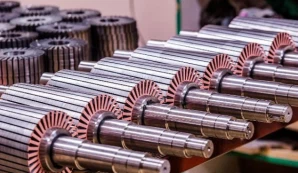
Several factors must be considered when selecting the appropriate steel for a motor.
Currently, the most commonly used material for motor cores is cold-rolled laminated steel, which is the lowest cost material for volume applications, and ease of stamping and low tool wear help reduce the cost of finished lamination. In applications where higher core losses (DC pole pieces, low duty cycle, etc.) and low cost end equipment are acceptable, carbon steel should be considered, although of course the magnetic and mechanical properties of this material are more decisive factors one. The thinner the material, the lower the high frequency eddy current losses and the higher the efficiency of the motor. This in turn means lower power consumption, and thus greater transmission distance range at the same power capacity level. According to the power formula below, the best material thickness is as thin as possible.

Thinner sheets, longer production times and reduced throughput
Taking the example of a motor with a stator outer diameter of 250 mm and a stack height of 120 mm, the thinner the sheet thickness, the more lamination is required to achieve the desired overall height. Stamping speed varies between 220 strokes/min (for 0.25 mm thick sheet) and 250 strokes/min (for 0.35 mm) depending on sheet thickness. Taking into account scrap, downtime and system availability, throughput will be between 32 stacks (0.35 mm) and 19 stacks (0.25 mm) per hour, which means a 1.7-fold increase in punching time.
Consider efficiency maximization, but not application independent
Strong electric motors can be produced with a large number of grades of steel, and when choosing a drive motor for pure electric operation, the primary question is how much you can save by using higher quality, thinner, and therefore more expensive, electrical steel. Even a relatively small difference in efficiency can affect the battery's range and thus the required (very expensive) battery capacity.
The performance curve is less demanding if the electric machine is only used to support the combustion engine in a mild hybrid vehicle, or if the vehicle is intended to be operated purely electric over short or medium distances (as in a hybrid or plug-in hybrid vehicle). In addition to the engine saving material, the required battery capacity is also significantly reduced, which is why it makes sense to reduce motor efficiency in the thickness range of 0.3 to 0.35 mm.
In addition, extremely thin core steel can improve the efficiency of high-speed motors, especially the stator, but in the rotor, it is often necessary to achieve very high strength, rather than thinner thickness, special joining processes, such as full surface bonding Together, the rotor design also has a positive effect on efficiency.
in conclusion
Thin is not always better, the use of core steel must be viewed very differently from the overall point of view of machinability, cost, application areas, efficiency and other technical factors of motor design, with many conditions clearly indicating that there are Facilitates the use of different thicknesses of steel.
How the material used for the rotor or stator laminations is selected has a fundamental and far-reaching impact on motor design, with core material affecting characteristics such as output, heat gain, weight, and cost (the term "motor" is used loosely here to include generators, tachometers, resolvers, alternators, etc.). Few engineering schools take the time to delve into this material selection, and since the various materials come from multiple suppliers, it can be difficult to find an overview of all of them in one place.


