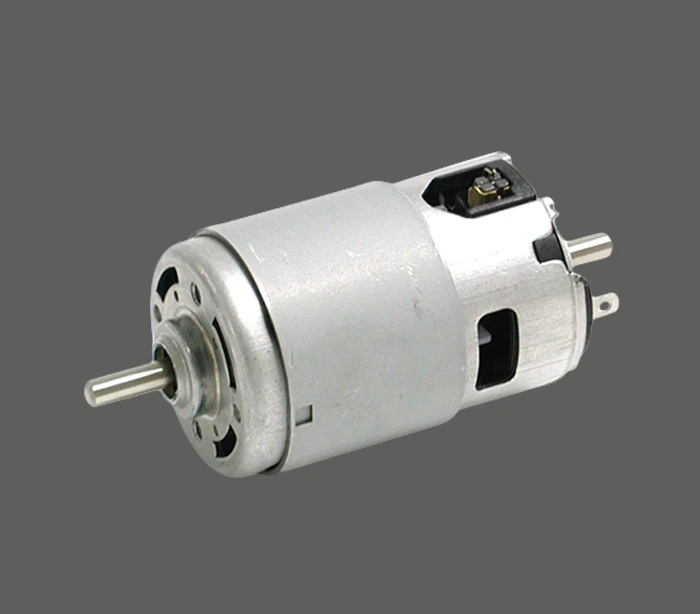
A brushless DC motor is a DC motor that does not require the brushes used in traditional brushed DC motors.
Compared with brushed DC motors, brushless DC motors have the following two advantages.
Long service life and therefore low maintenance frequency.
no noise

The brushes used in brushed DC motors are in constant contact with the commutator. Regular replacement is required as motor rotation causes brushes and commutators to wear out over time. The associated short life and maintenance requirements are disadvantages of such motors. In contrast, because BLDC motors do not use these consumable commutators and brushes, they have a longer lifespan and are much less frequently maintained. Therefore, the frequency of use of brushless DC motors is getting higher and higher.
The fact that brushless DC motors do not use commutators and brushes also means that electrical and acoustic noise caused by contact between these components is eliminated. Therefore, brushless DC motors operate very quietly.
Where are brushless DC motors used?
Brushless DC motors offer quiet operation, long life and low maintenance and can be used in a variety of applications. Common examples include home appliances such as air conditioners, air purifiers, and refrigerators.
These motors are also used in a variety of commercial equipment, including industrial printers, vending machines, water heaters, and projectors. Along with other applications such as automotive and large industrial machinery, brushless DC motors have become an essential part of our lives.
Does a brushless DC motor need a driver circuit?
As mentioned above, electronic control is required to drive a BLDC motor, rather than mechanical control. The reason for this can be explained by the difference in the generation of rotating magnetic fields in brushless DC motors from other motors.
In order to make the motor spin, you need to change the direction of the current flowing through the motor windings and create a rotating magnetic field. While induction motors and other motors driven by AC power can use AC power voltage to achieve this, DC-driven motors require some form of switch to change the direction of the current in the motor, thereby creating a rotating magnetic field.
In the case of brushed DC motors, this is achieved through the use of brushes and commutators. However, with brushless DC motors, instead of using short-lived brushes, the alternation of current and the consequent rotating magnetic field are achieved by semiconductor switches such as bipolar transistors or FETs. Life is not a big problem.
Coil configuration and switching for brushless DC motors
Brushless DC motors generally have three coils. One end of the three coils are connected together, so by connecting the other end of one coil to the positive and the other end of the other to the negative, current flows through both coils. Two semiconductor switches are connected to each coil, one to the positive and the other to the negative. This gives a total of six switches that, when opened and closed in the correct order, cause the motor to spin. The timing of this switching is determined by the rotor orientation detected by the Hall sensors.
In other words, turning semiconductor switches on and off in the correct sequence creates a rotating magnetic field that spins a brushless DC motor. Therefore, a driver circuit is required to perform these sequence of steps.
The composition of the brushless DC motor drive circuit
The drive circuit consists of the following main components.
Rotary position sensor
Hall sensors for detecting the N and S poles of the rotor magnets.
position detection circuit
A circuit that converts the signal from the Hall sensor to a digital logic signal.
logic circuit
Based on the signal from the rotor position detection sensor, the circuit outputs a sequence that controls the direction of current flowing through each coil.
pre-driver circuit
A circuit that converts a sequenced signal into a signal used to turn semiconductor switches on and off.
semiconductor switch
Typically six semiconductor switches are used. They turn on and off based on sequencing signals to allow current to flow through the coils needed to spin the motor.
Motor drive power
A power supply is required to provide current through the motor coils and to power the logic and sensor circuits.
In this way, although a drive circuit is required, brushless DC motors have high performance because they do not suffer from the noise and short life problems of brushed DC motors.
Learn more about how brushless DC motors are controlled
Because they don't use commutators and brushes, driving brushless DC motors requires electronic control rather than using a mechanical mechanism, which is done using a drive circuit. The drive circuit is composed of a rotary position sensor, a position detection circuit, a logic circuit, a pre-drive circuit, a semiconductor switch, and a motor drive power supply. Anyone working on building electronics that incorporate brushless DC motors needs to have a deep understanding of what each element does. We hope the information provided here is helpful to you.