


Types of brushed DC motors
The current brushed DC motors for electric vehicles are divided into series-excited motors and separately-excited motors
These two types of motors have the same shape and different internal materials and processes. How to distinguish between series-excited and separately-excited motors?
I will show you a way to distinguish the type of motor by looking at the terminals.
Series motor: The four terminals are A1, A2, D1, D2, and the diameter of the four motor connecting wires is the same, which is a series motor.
A motor whose excitation and armature windings are connected in series with DC power supply is called a DC series motor.
Separately excited motor: The four terminals are A1, A2, F1, and F2, and they can be distinguished from the motor connecting lines. A1 and A2 are thick wires, and F1 and F2 are thin wires. This is the separately excited motor.
The excitation coil and armature winding are DC motors with separate power supply, called DC separately excited motors.
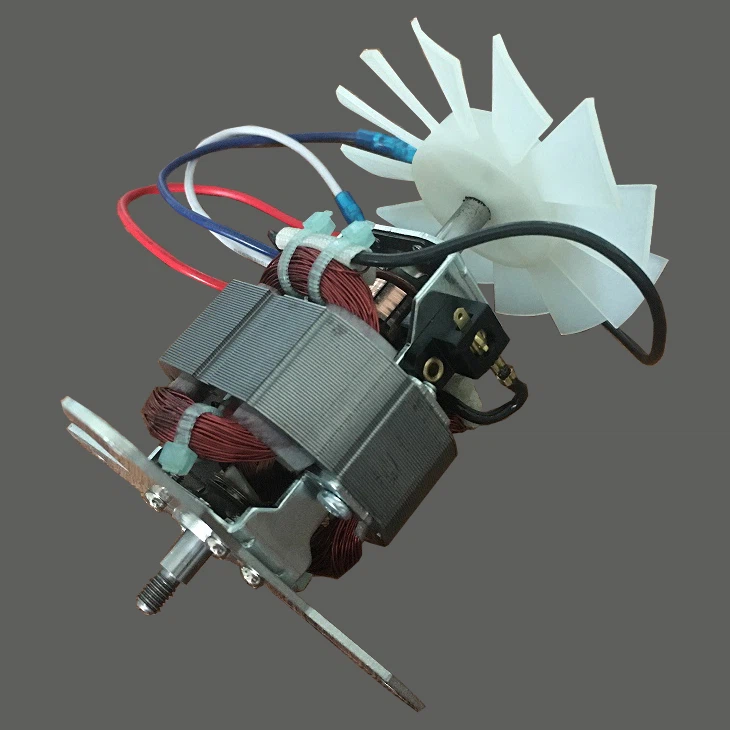
How to judge whether the motor is good or bad?
Look at the surface of the motor
1. Carefully observe whether the surface of the motor is clean, whether there is oil pollution, traces of water entering, water or oil pollution, which will cause the motor to short-circuit and burn the motor.
2. Whether there is a short-circuit or open circuit of the motor connecting wire and terminal, whether the connecting wire is connected to the motor will heat up, and the current will increase and burn the motor.
3. Open the motor carbon brush cover to see the wear state of the carbon brush and the elasticity and smoothness of the compression spring. Whether the four carbon brushes are the same length.
The degree of wear and tear of the commutator, whether there are grooves, black burns, or copper tumors, the normal commutator is smooth and bright.
The burnt motor stator and rotor coils are black, and there is a phenomenon of burning and burning insulating paint. The good motor stator and rotor coils are yellow, and the surface is clean and shiny.
Is there a burning smell
The premise of burning the motor is that the short circuit is caused by the heat generated by the increase of the current. The motor after high temperature will have a strong smell of burning insulating paint, which is very unpleasant.
The pungent smell of a lightly burned motor will be less, and a severely burned motor will have an unpleasant burnt smell a few meters away.
The burning smell of this insulating paint is enough to judge whether the motor is burned out.
Directly energize to test the quality of the motor
The electric vehicle cannot be used. If the reason cannot be found, the elimination method can be used to directly test the quality of the motor.
1. Short-circuit the A2 and D2 terminals of the series excitation motor, find a 12v battery, A1 is connected to the positive electrode of the battery, and D1 is connected to the negative electrode of the battery.
2. The stator excitation and rotor windings of the separately excited motor are powered separately, so two 12v batteries are used, one of which is connected to F1 with its positive pole and F2 with its negative pole, and the other with A1 with its positive pole and A2 with its negative pole. The motor works normally. Turn it up to indicate that the motor is normal, otherwise the motor is damaged (the positive poles of the two batteries should be connected to the motors A1 and F1 at the same time during the test).
Multimeter to measure motor failure
Remove the motor wire, use a multimeter to measure whether the motor is short-circuited or open-circuited, and adjust the multimeter to the buzzer gear.
It is good to measure the conduction between D1 and D2. If they are not connected, the circuit is broken and the motor is broken.
Before measuring A1 and A2, you can open the carbon brush cover for a visual inspection to see if the carbon brush and wiring are complete and then measure. Check the cause of the disconnection.
Separately measure whether there is continuity between the 4 terminals and the motor shell, and whether the rotor and the stator are connected. If there is no continuity, it is normal, and if it is connected, the short-circuit motor is bad.
Separately-excited motors are measured in the same way as series-excited motors. F1 is connected to F2, A1 is connected to A2, and the four terminals are not connected to the motor shell.

Why do DC motors fail?
The motor is not damaged by use, but is damaged by blind and careless use. This sentence is not alarmist. Just like people, very few people really die of life, and most of them die of illness.
The life of a normal electric vehicle DC motor is 10 years, or 150,000 kilometers, and very few of them really reach the service life.
There are usually several reasons for the failure of the motor:
1. Driving without power
Electric vehicles drive slowly or climb slopes in the case of power loss, resulting in overcurrent and high temperature of the motor, which may burn the motor at one time.
The correct use method should be charged in time. If the battery capacity is seriously attenuated, the battery should be replaced.
Some motor controllers do not have a minimum voltage protection function, and running without power can damage both the motor and the battery.
Some controllers have no temperature control protection, and the motor cannot be decelerated or powered off to protect the motor when the motor is high temperature.
2. Overload driving
Overloaded high-speed driving, overloaded climbing steep slopes, and desperately climbing up in a ditch may burn the motor or controller. Even if it is not damaged at the time, it will leave permanent scars and hidden dangers.
Suggestion: Reduce the speed of the vehicle appropriately when it is full of people. In case of a car trap, do not climb hard, because the motor is difficult to release due to the excessive current, which will form welding-like heat, which will burn the motor or the controller.
3, wading driving
Let me tell you a truth, there is no electrical appliance in the world that is not afraid of water, and the life of a submersible pump is only two or three years, not to mention the electric motor used on land.
Remember: often wading in water, the water will enter the motor sooner or later, and the motor will not be damaged when it enters the water. It still needs a process, which may be 1 month or 1 year or 2 years.
Driving in water will short-circuit the stator and rotor, and the carbon brushes will stick to the commutator, which may also immediately burn the motor.
The composition of water is many metals, salts, acids, etc. Even if the water flows out after entering the water, it will corrode the iron core and produce rust, and corrode the bearing, causing the bearing to heat up, dry, rust, damage the bearing, and impurities such as rust will cause the motor. Short circuit, heat generation, high temperature, increased current, and even burn out the controller, the motor will be short-lived over time.
The correct use method is to drive less in rainy days and avoid wading. If unavoidable wading occurs, please dry the water inside the motor before use.
4. It is forbidden to slide or drag the DC motor:
When a vehicle equipped with a DC motor fails to travel, remember not to drive it, because the motor stator excitation and rotor winding will generate current (like a generator) when the motor is idling, and the current generated during towing will burn the motor coil.
Suggestion: tow away but not at 20 km/h and turn on the car key. The best way is to find a rescue vehicle to load it up and take it away.
5. Lack of maintenance
Some users' cars are just like rented cars. They only know how to drive but don't know how to maintain them. If they drive, they will be confused.
The correct use method is: maintenance once every 5000 kilometers, check whether the motor connecting wire and terminal are connected, loose or grounded.
Clean the dust and carbon brushes inside the motor. Friction in the motor will generate static electricity or short-circuit the rotor and stator.
Check the wear degree of the carbon brushes, whether the lengths and wear angles of the four carbon brushes are the same, and whether the elasticity of the circlip is normal. If there is any abnormality, replace it in time.
Whether the copper head of the commutator is neat and bright, if there is burnt or ditch, you can use gauze to rub it to brighten it or turn it to a lathe to prolong the life of the motor.

Common faults of DC motors
One, high temperature
The high temperature of the motor is an omen that the motor will have a problem. After the high temperature occurs, the electric vehicle starts to consume power quickly, and it is unable to climb the slope at a slow speed, which significantly shortens the cruising range. The reason is that the motor excitation coil is short-circuited, and the stator and the casing are short-circuited.
After diagnosis, it can be solved by maintenance.
Low battery voltage or running without electricity will cause high temperature of the motor. Please check the battery voltage and power. Replace the battery as soon as possible.
Overload driving will also cause high temperature of the motor, be careful not to overload.
2. Often bad carbon brushes, caused by bad driving habits:
1, wading driving
The water entering the motor during wading driving is conductive, which will cause a multi-pole short circuit between the carbon brush and the commutator.
2. Quick start and sudden braking
3. The phenomenon of excessive acceleration is that the current suddenly increases, and it is difficult to completely conduct and release the carbon brush and the commutator for a while, resulting in damage to the contact surface of the carbon brush and the commutator and shortening the life of the carbon brush.


