Structural form and main classification of hub motor
What is a hub motor? As the name implies, the motor is made inside the wheel and drives the wheel directly. Wheel hub motor technology, also known as wheel-mounted motor technology, is characterized by the integration of power, transmission and braking devices into the hub, thus greatly simplifying the mechanical part of the electric vehicle. Wheel hub motor technology is not new. As early as 1900, electric vehicles with front wheel wheel motors were manufactured. In the 1970s, this technology was applied in mine transport vehicles and other fields. For the hub motors used in passenger cars, Japanese manufacturers have carried out earlier research and development of this technology, and are currently in a leading position. International auto giants including General Motors and Toyota have also been involved in this technology.
Hub motor structure
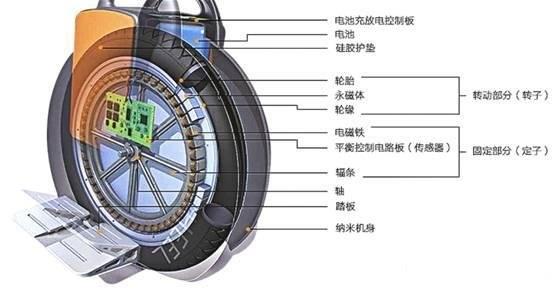
The hub motor power system usually consists of an electric motor, a speed reduction mechanism, a brake and a heat dissipation system. The hub motor power system is mainly divided into two types according to the rotor type of the motor: an inner rotor type and an outer rotor type. The figure shows a schematic diagram of the structure of two types of hub motors. Generally, the outer rotor type uses a low-speed external sub-motor. The maximum speed of the motor is about 1000-1500r/min. There is no deceleration device. The outer rotor of the motor is fixed or integrated with the wheel rim. The rotation speed of the wheel is the same as that of the motor. The inner rotor type uses a high-speed inner rotor motor and is equipped with a fixed gear ratio reducer. In order to achieve a higher power density, the speed of the motor is typically as high as 10,000 r/min. The deceleration structure usually adopts a planetary gear reduction device with a transmission ratio of about 10:1, and the rotation speed of the wheel is about 1000r/min.
The high-speed inner rotor hub motor has high specific power, light weight, small volume, high efficiency, low noise and low cost. The disadvantage is that the speed reducer must be used to reduce the efficiency, the non-sprung mass increases, and the maximum speed of the motor Limited by factors such as coil loss, friction loss, and the ability of the shifting mechanism to withstand. The low-speed outer rotor motor has a simple structure, small axial dimension, high specific power, can control torque over a wide speed range, and has a fast response speed. The outer rotor is directly connected to the wheel, and there is no speed reduction mechanism, so the efficiency is high; In order to obtain a large torque, the engine volume and mass must be increased, so that the cost is high, the efficiency is low during acceleration, and the noise is large. The figure shows the hub motor in two configurations. Both of these structures are used in current electric vehicles, but with the advent of compact planetary gear shifting mechanisms, high-speed internal rotor drive systems are more competitive in power density than low-speed outer rotors.
The hub motor power system usually requires an additional mechanical brake system because the motor has a small electric brake capacity and cannot meet the requirements of the vehicle's braking performance. The brakes in the hub motor system can be drum or disc brake depending on the structure. Due to the existence of the electric braking capacity of the motor, the design capacity of the brake can be appropriately reduced. Most of the hub motor systems use air-cooled cooling, and water-cooled and oil-cooled heat-dissipating components such as motors and brakes, but the structure is more complicated.
Type classification of motor magnetic field
The drive motor of the hub motor system is divided into two types: radial magnetic field and axial magnetic field according to the type of motor magnetic field. The comparison is as follows:
(1) The structure of the axial flux motor is more conducive to heat dissipation, and its stator may not require a core;
(2) The force between the stator and the rotor of the radial flux motor is relatively balanced, and the magnetic routing silicon steel sheet is laminated, and the technology is simpler and more mature.
The motor type of the hub motor is divided into permanent magnet, induction, and switched reluctance. Its characteristics are as follows:
(1) Induction (asynchronous) motor is simple in structure, durable, low in cost, reliable in operation, small in torque ripple, low in noise, no position sensor, high speed limit; disadvantages are complicated driving circuit and high cost, relatively permanent magnet motor In terms of asynchronous motor efficiency and power density;
(2) Brushless permanent magnet synchronous motor can adopt cylindrical radial magnetic field structure or disc axial magnetic field structure, with high power density and efficiency and wide speed regulation range. The development prospect is very broad, and it has been widely used at home and abroad. Applicable to electric vehicles;
(3) Switched reluctance motor has the characteristics of simple structure, low manufacturing cost, good speed/torque characteristics, etc. It is suitable for electric vehicle driving; the disadvantage is that design and control are very difficult and fine, and the running noise is large.