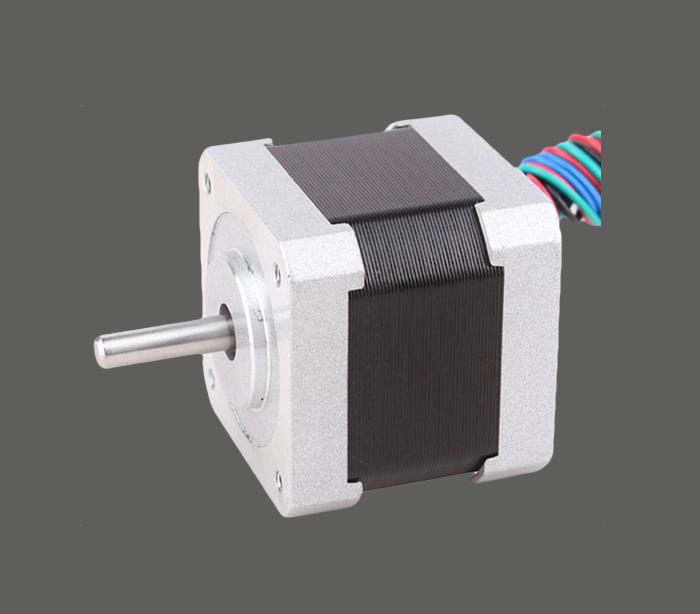
Stepper motor dynamic indicators and terminology:
1. Step angle accuracy: The error between the actual value of the stepping motor and the theoretical value of each step angle. Expressed as a percentage: error / step angle * 100%. The values of different running beats are different. The four-shot operation should be within 5%, and the eight-shot operation should be within 15%.
2. Out of step: The number of steps in the operation of the motor is not equal to the theoretical number of steps. Call it out of step.
3. Offset angle: The axis of the rotor tooth is offset from the axis of the stator tooth. There must be an offset angle in the motor operation. The error caused by the misalignment angle cannot be solved by subdivision driving.
4. Maximum no-load starting frequency: The maximum frequency that the motor can directly start without load under certain driving forms, voltages and rated currents.
5. Maximum no-load operating frequency: The maximum speed of the motor without load under certain driving forms, voltage and rated current.
6. Operating torque frequency characteristics: The curve of the relationship between the output torque and the frequency of the motor measured under certain test conditions is called the running torque frequency characteristic. This is the most important of the many dynamic curves of the motor and the fundamental basis for the motor selection. As shown below
Other characteristics include inertial frequency characteristics, starting frequency characteristics, and the like. Once the motor is selected, the static torque of the motor is determined, but the dynamic torque is not. The dynamic torque of the motor depends on the average current (not the quiescent current) when the motor is running. The larger the average current, the larger the output torque of the motor, that is, the motor. The harder the frequency characteristics. As shown below:
Among them, curve 3 has the largest current or the highest voltage; curve 1 has the smallest current or the lowest voltage, and the intersection of the curve and the load is the maximum speed point of the load. In order to make the average current large, the driving voltage is increased as much as possible, so that a motor with a small inductance and a large current is used.