


Motor explanation丨Switched reluctance motor
The switched reluctance motor drive system (srd) consists of four parts: switched reluctance motor (srm or sr motor), power converter, controller and detector. The rapid development of a new type of speed control drive system developed. Switched reluctance motor is a double salient reluctance motor, which uses the principle of minimum reluctance to generate reluctance torque. Because of its extremely simple and sturdy structure, wide speed regulation range, excellent speed regulation performance, and relatively high speed in the entire speed regulation range. High efficiency and high system reliability make it a strong competitor of AC motor speed control system, DC motor speed control system and brushless DC motor speed control system. Switched reluctance motors have been widely or began to be used in various fields such as electric vehicle drives, household appliances, general industry, aviation industry and servo systems, covering various high and low speed drive systems with a power range of 10w to 5mw, showing huge market potential.
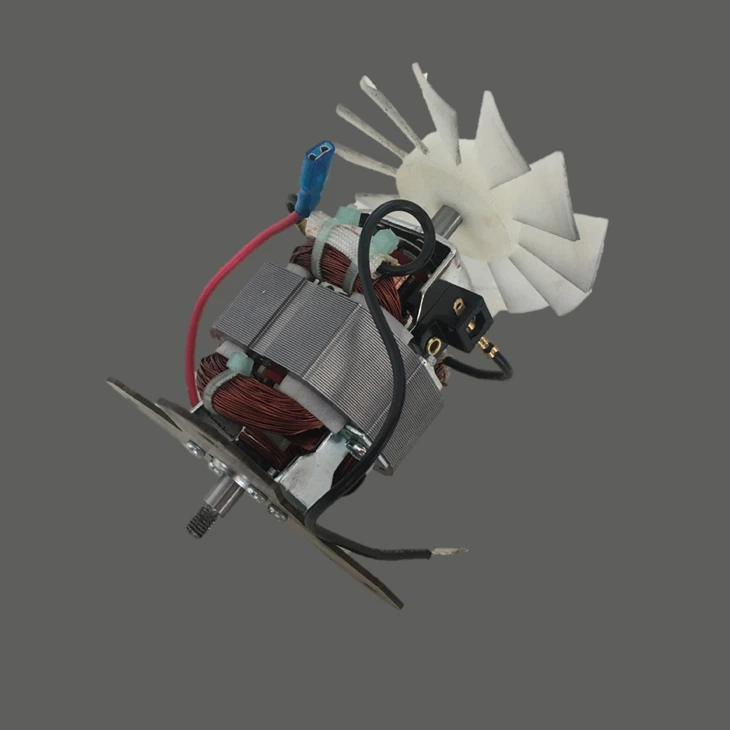
2 Structure and performance characteristics
2.1 The motor has a simple structure, low cost, and is suitable for high speed
The structure of the switched reluctance motor is simpler than that of the squirrel-cage induction motor which is generally considered to be the simplest. The stator coil is a concentrated winding, which is easy to embed, the end is short and firm, and the operation is reliable. Vibration environment; the rotor is only made of silicon steel sheets, so there will be no problems such as poor squirrel cage casting and broken bars in use during the manufacturing process of squirrel cage induction motors. The rotor has extremely high mechanical strength and can work at extremely high speeds. up to 100,000 revolutions per minute.
2.2 Simple and reliable power circuit
The torque direction of the motor has nothing to do with the direction of the winding current, that is, only the winding current in one direction is required, and the phase winding is connected between the two power tubes of the main circuit, and there will be no bridge arm straight-through short-circuit fault. , The system has strong fault tolerance and high reliability, and can be applied to special occasions such as aerospace.
2.3 High starting torque, low starting current
The products of many companies can achieve the following performance: when the starting current is 15% of the rated current, the starting torque is 100% of the rated torque; when the starting current is 30% of the rated value, the starting torque can reach 150% of the rated value. %. Compared with the starting characteristics of other speed control systems, such as DC motor with 100% starting current, obtain 100% torque; squirrel cage induction motor with 300% starting current, obtain 100% torque. It can be seen that the switched reluctance motor has soft-start performance, the current impact is small during the starting process, and the heating of the motor and the controller is smaller than that of the continuous rated operation, so it is especially suitable for frequent start-stop and forward and reverse operation occasions, such as gantry planer, Milling machines, reversible rolling mills in the metallurgical industry, flying saws, flying shears, etc.
2.4 Wide speed regulation range and high efficiency
The operating efficiency is as high as 92% at rated speed and rated load, and the overall efficiency is maintained as high as 80% in all speed ranges.
2.5 There are many controllable parameters and good speed regulation performance
There are at least four main operating parameters and common methods for controlling switched reluctance motors: phase turn-on angle, relevant break-off angle, phase current amplitude and phase winding voltage. There are many controllable parameters, which means the control is flexible and convenient. According to the operating requirements of the motor and the conditions of the motor, different control methods and parameter values can be used to make it run in the best state, and it can also achieve various functions and Specific characteristic curves, such as making the motor have the exact same four-quadrant operation (forward, reverse, motoring and braking) capability, with high starting torque and load capacity curves for series motors.
2.6 It can meet various special requirements through the unified and coordinated design of machine and electricity

3 Typical applications
The superior structure and performance of the switched reluctance motor make its application field very extensive. The following three typical applications are analyzed.
3.1 Gantry planer
The gantry planer is a main working machine in the machining industry. The working method of the planer is that the worktable drives the workpiece to reciprocate. When it moves forward, the planer fixed on the frame plans the workpiece, and when it moves backward, the planer lifts the workpiece. From then on, the workbench returns with a blank line. The function of the main transmission system of the planer is to drive the reciprocating motion of the worktable. Obviously, its performance is directly related to the processing quality and production efficiency of the planer. Therefore, the transmission system is required to have the following main performances.
3.1.1 Main Features
(1) It is suitable for frequent starting, braking and forward and reverse rotation, no less than 10 times per minute, and the starting and braking process is smooth and fast.
(2) The static difference rate is required to be high. The dynamic speed drop from no-load to sudden knife loading is not more than 3%, and the short-term overload capability is strong.
(3) The speed regulation range is wide, which is suitable for the needs of low-speed, medium-speed planing and high-speed reverse travel.
(4) The work stability is good, and the return position of the round trip is accurate.
At present, the main drive system of domestic planer mainly has the form of DC unit and the form of asynchronous motor-electromagnetic clutch. A large number of planers mainly driven by DC units are in a state of serious aging, the motor is severely worn, the sparks on the brushes are large at high speed and heavy load, the failure is frequent, and the maintenance workload is large, which directly affects the normal production. . In addition, the system inevitably has the disadvantages of large equipment, high power consumption and high noise. The asynchronous motor-electromagnetic clutch system relies on the electromagnetic clutch to realize the forward and reverse directions. The clutch wears seriously, the working stability is not good, and it is inconvenient to adjust the speed. It is only used for light planers.
3.1.2 Problems with Induction Motors
If the induction motor variable frequency speed regulation drive system is used, the following problems exist:
(1) The output characteristics are soft, so that the gantry planer cannot carry enough load at low speed.
(2) The static difference is large, the processing quality is low, the processed workpiece has patterns, and it even stops when the knife is eaten.
(3) The starting and braking torque is small, the starting and braking are slow, and the parking offside is too large.
(4) The motor heats up.
The characteristics of the switched reluctance motor are especially suitable for frequent starting, braking and commutation operation. The starting current during the commutation process is small, and the starting and braking torques are adjustable, thus ensuring that the process requirements are matched within various speed ranges. meets the. The switched reluctance motor also has a high power factor. Whether it is high or low speed, no-load or full-load, its power factor is close to 1, which is better than other transmission systems currently used in gantry planers.
3.2 Washing machine
With the development of the economy and the continuous improvement of people's quality of life, the demand for environmentally friendly and intelligent washing machines is also increasing. As the main power of the washing machine, the performance of the motor must be continuously improved. At present, there are two kinds of popular washing machines in the domestic market: pulsator and drum washing machines. No matter what kind of washing machine, the basic principle is that the motor drives the pulsator or the drum to rotate to generate water flow, and then the water flow and the force generated by the pulsator and the drum are used to wash the clothes. The performance of the motor determines the operation of the washing machine to a large extent. The state, that is, determines the quality of washing and drying, as well as the size of noise and vibration.
At present, the motors used in the pulsator washing machine are mainly single-phase induction motors, and a few use frequency conversion motors and brushless DC motors. The drum washing machine is mainly based on series motor, in addition to variable frequency motor, brushless DC motor, switched reluctance motor.
The disadvantages of using a single-phase induction motor are very obvious, as follows:
(1) can not adjust the speed
There is only one rotation speed during washing, which is difficult to adapt to the requirements of various fabrics for washing rotation speed, and the so-called "strong wash", "weak wash", "gentle wash" and other washing procedures change only by changing the continuous forward and reverse rotation. Time is only, and in order to take care of the rotation speed requirements during washing, the rotation speed during dehydration is often low, generally only 400 rpm to 600 rpm.
(2) The efficiency is very low
The efficiency is generally below 30%, and the starting current is very large, which can reach 7 to 8 times of the rated current. It is difficult to adapt to the frequent forward and reverse washing conditions.
The series motor is a DC series motor, which has the advantages of large starting torque, high efficiency, convenient speed regulation, and good dynamic performance. However, the disadvantage of the series motor is that the structure is complex, the rotor current needs to be mechanically commutated through the commutator and the brush, and the sliding friction between the commutator and the brush is prone to mechanical wear, noise, sparks and electromagnetic interference. This reduces the reliability of the motor and shortens its life.
The characteristics of the switched reluctance motor make it possible to achieve good results when applied to washing machines. The switch reluctance motor speed control system has a wide speed control range, which can make "washing" and
Spinning "all work at the best speed to achieve true standard washing, quick washing, gentle washing, velvet washing, and even variable speed washing. You can also choose the speed of rotation at will when spinning. You can also press certain settings. The program can increase the rotation speed, so that the clothes can avoid vibration and noise caused by uneven distribution during the dehydration process. The excellent starting performance of the switched reluctance motor can eliminate the impact of the frequent forward and reverse starting current of the motor during the washing process on the power grid, making the washing process easier. , The commutation is stable and noiseless. The high efficiency of the switch reluctance motor speed regulation system in the entire speed regulation range can greatly reduce the power consumption of the washing machine.
The brushless DC motor is indeed a strong competitor to the switched reluctance motor, but the advantages of the switched reluctance motor are low cost, robustness, no demagnetization and excellent starting performance.
3.3 Electric Vehicles
Since the 1980s, due to people's increasing attention to environmental and energy issues, electric vehicles have become an ideal means of transportation due to their advantages of zero emissions, low noise, wide power sources, and high energy utilization. Electric vehicles have the following requirements for the motor drive system: high efficiency in the entire operating area, high power density and torque density, wide operating speed range, and the system is waterproof, shock-resistant and impact-resistant. At present, the mainstream motor drive systems for electric vehicles include induction motors, brushless DC motors and switched reluctance motors.
The switched reluctance motor speed control system has a series of characteristics in performance and structure, which make it very suitable for electric vehicles. It has the following advantages in the field of electric vehicles:
(1) The motor has a simple structure and is suitable for high speed. Most of the loss of the motor is concentrated on the stator, which is easy to cool and can be easily made into a water-cooled explosion-proof structure, which basically requires no maintenance.
(2) High efficiency can be maintained in a wide range of power and speed, which is difficult for other drive systems to achieve. This feature is very beneficial to improve the driving course of electric vehicles.
(3) It is easy to realize four-quadrant operation, realize energy regeneration feedback, and maintain strong braking ability in high-speed operation area.
(4) The starting current of the motor is small, there is no impact on the battery, and the starting torque is large, which is suitable for heavy-load starting.
(5) Both the motor and the power converter are very sturdy and reliable, suitable for various harsh and high temperature environments, and have good adaptability.
In view of the above advantages, there are many practical applications of switched reluctance motors in electric vehicles, electric buses and electric bicycles at home and abroad.


