Calculation method
When the movement structure is determined and the speed or torque of the output shaft of the transmission mechanism has been determined according to the toy action design, the load torque of the motor shaft can be calculated.
For the gear transmission mechanism, the rotation ratio and mechanical efficiency are both fixed values. As long as the resistance torque and speed of the output shaft of the toy transmission mechanism are known, the driving torque of the motor can be calculated. According to the obtained values, the technical performance parameter table of the motor can be checked to select a suitable motor. Considering the changes in the actual load of the toy, the rated torque of the selected motor should be greater than the calculated driving torque.
Although the above two methods are more scientific and accurate, in fact, due to the complex changes in the toy load and the fact that power calculations are generally not performed in toy design, the load torque of the toy is difficult to determine, so they are rarely used in actual motor selection. The commonly used method is the habitual selection method, which includes the empirical method, the analogy method and the test method.
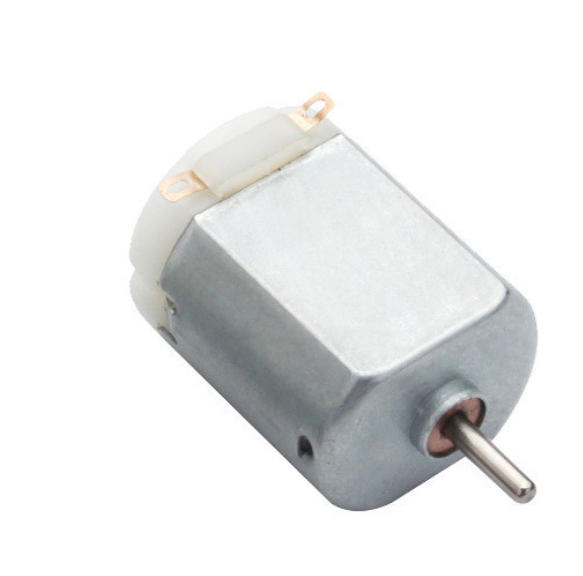
The empirical method refers to the designer selecting a suitable motor based on the long-term work experience and the type of toy action. For example, the commonly used motor types are F130, F260, F280, R140, R260, R280, etc., and then determining the specific model based on the size, weight, and complexity of the toy.
The analogy method refers to finding a toy with similar specifications, dimensions, and actions to your own design in the existing toys, conducting electrical performance tests, and then making a selection based on the test results.
The experimental method refers to the initial selection of a model from the commonly used motor types, performing design calculations, trial-making movement samples based on the calculation results, adding the normal load of the toy to the sample, measuring its load current, and then checking whether the efficiency curve corresponding to the current value is close to the highest point based on the motor characteristic curve. If so, the motor is suitable, otherwise replace the motor and conduct the test again.