With the rapid development of science and technology, all kinds of robot products have also entered our daily life. For example, sweeping robots drive small brooms to clean the ground through DC motors, intelligent early childhood education robots accompany children to grow up, and industrial robotic arm robots can replace manual assembly of products.
No matter what kind of robot it is, it must be driven by a power source, and this power source is a DC motor. In the design of robots, the DC motor is a very important driving structure, which is equivalent to the movable joint of human beings. The DC motor provides driving torque for the robot by converting electrical energy into mechanical energy, so the DC motor is installed in the position where the robot needs to move (such as joint drive, wheels, etc.).
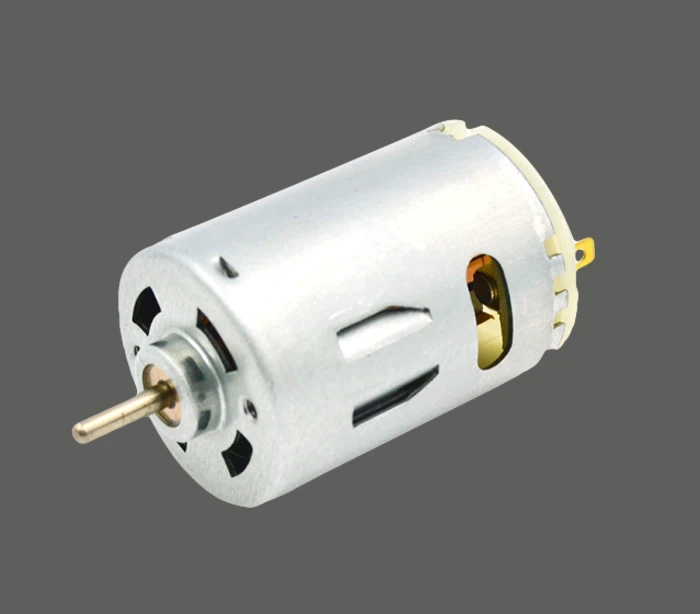
In the field of robotics, DC motors are used because they can be powered by DC power from batteries. There are brushed DC motors and brushless DC motors in DC motors. Different DC motors are selected according to needs, such as robot steering gear, Most of the brushed DC motors are used. The brushed DC motor has a simple structure and is commutated through the commutator. However, the brushed DC motor has a disadvantage that the brush and the commutator will produce friction when the motor is running, which will affect the use. Of course, if the service life of the brushed DC motor in some robots can meet the requirements, the brushed DC motor will still be selected.
The brushless DC motor solves the problem of the brushed DC motor. It has no commutator and uses electronic commutation, so there is no wear and tear, and the service life is much longer than that of the brushed DC motor, but the brushless DC motor The structure of the motor is more complicated and the price is more expensive. Unless the parameters of the brushed DC motor cannot be satisfied, the brushless DC motor will be selected.
The rotation speed and forward and reverse rotation of the DC motor are also very important for the robot. Its walking speed and working speed are closely related to the rotation speed, so it needs to be controlled by the DC motor driver.
When the rotor of the DC motor rotates, the stator winding will generate back electromotive force, and the back electromotive force waveform generated by the structure of the motor is also different, that is, square wave and sine wave. DC motor speed regulation can change the output voltage by PWM modulating the pulse width of the square wave, and the speed will change with the voltage change.
The use of sine wave current drive can effectively reduce the torque ripple, but the disadvantage is that the control process is complicated and the cost is high. Although the sine wave driving the DC motor is also a full bridge circuit, its speed regulation method is different from that of the square wave drive, and the vector control method (FOC for short) is used in the robot.
DC motor FOC control: The DC motor can rotate because the interaction of the magnetic field and the current generates torque. The magnitude of the torque is related to the magnetic field and the current, but the magnetic field generated by the stator is fixed, so the torque can be controlled by controlling the current. That is to say, the speed of the DC motor can be controlled, but the current of the brushless DC motor will not only generate torque, but also the magnetic flux material in the stator and generate a magnetic field, which is what we often call the excitation current. The coupling of these two undoubtedly increases the difficulty of control.
If you want to control the speed, you need to separate these two currents and control them separately. FOC uses coordinate rotation to change the current of the decomposed stator. After decomposition, you can control these two quantities separately. The torque is large, the force is large, and the DC motor The speed went up. The advantage of FOC is that the torque ripple is small, so the rotation is very smooth, but its algorithm is complex and the cost is high.
By controlling the speed of the DC motor, the walking speed of the robot can be controlled, so that the robot will move!
Finally, summarize the two types of DC motors for robots
The brushless motor has no brush commutator structure, does not require regular maintenance, and has a long life. In terms of driving principle, the driving of brushless motor is divided into square wave driving and sine wave driving. The former has a simple principle and low cost, while the latter has a more complicated algorithm, but it can effectively suppress the torque ripple and make the motor rotate more smoothly.
In practical applications, we can choose the appropriate motor scheme and drive scheme according to the actual needs and comprehensive consideration of various factors. The brushless DC motor has low cost and large mechanical wear, and can be used as the wheeled chassis structure of the robot; one of the advantages of the brushless motor is that it does not generate sparks during commutation, so it is widely used in special robots.