

DC motors and AC motors are widely used in industrial production and daily life, and many studies and summaries have been conducted on their differences. Here's an introduction to their differences.
1. Different working principles
A DC motor provides current through a DC power supply to generate a magnetic field and achieve conversion between mechanical energy and electrical energy. In a DC motor, the direction of the current always remains the same, that is, there is only one direction. The principle of an AC motor is to generate an induced electromotive force through the action of an alternating electric field, thereby realizing the operation of the motor. Its current can repeatedly change direction while the input voltage continues to change in reverse.
2. Different structures
The structure of the DC motor is relatively simple. It completes the conversion through a pair of magnetic poles and a rotor. There is a energized coil inside the rotor, and the magnetic field force of the permanent magnet or electromagnetic pole is used to emit the force of the magnetic field, thereby realizing the rotation of the rotor. The structure of AC motors is more complex and comes in different models, including asynchronous motors, synchronous motors, linear motors and other structures, with higher performance and adaptability.
3. Different usage occasions
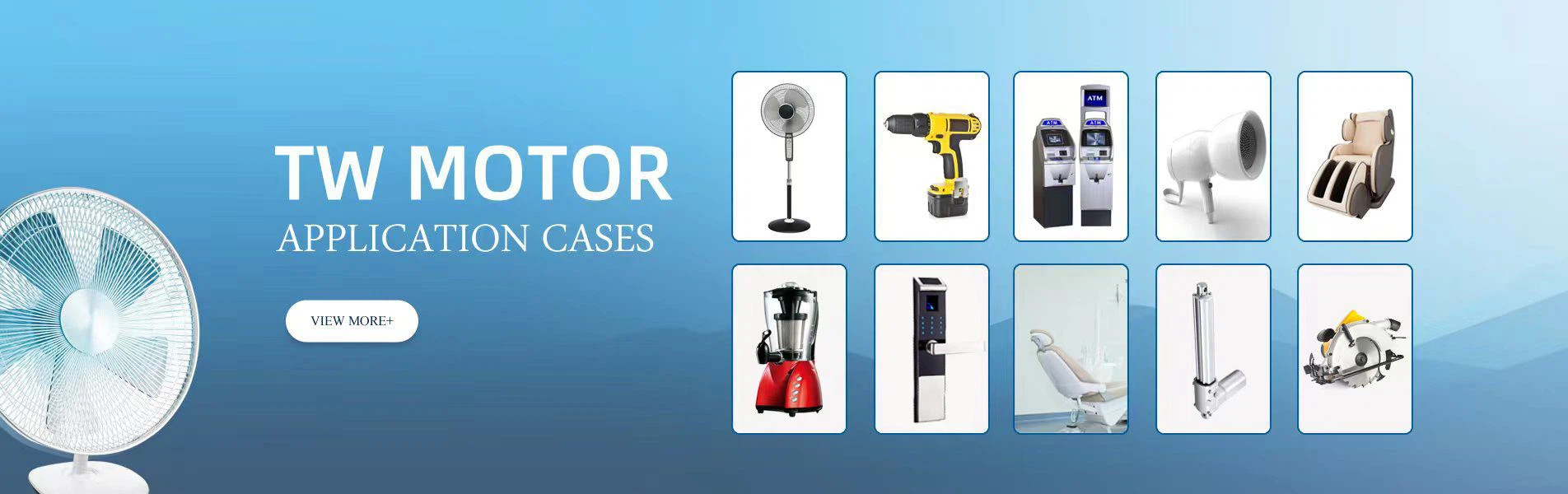
DC motors are widely used in household appliances, automobiles, robots, industrial production and other fields, and are suitable for occasions where precise speed adjustment and direction control are required. However, due to the high speed of the DC motor, it requires a more complex control system, so it is not suitable for certain occasions when higher reliability and stability are required. In contrast, AC motors have a wider range of applications and are usually used in large mechanical equipment, generators, power tools, railway transportation and other fields that require high power output. They occupy an important position in the manufacturing industry.
To sum up, although DC motors and AC motors both convert electrical energy into mechanical energy, their working principles, structures and usage occasions are different. Selecting the corresponding motor according to different working environments and usage directions can improve production efficiency and reduce production costs.


