


With the development of urban construction, a large amount of dust "relentlessly" invaded the corners of our lives. Of course, humans have also been fully armed - the vacuum cleaner has become the cleaning tool of choice for most households.
At the same time, the removal of dust mites, dust, mold and other invisible fine dust has also attracted more and more attention. It is also clear that in order to more effectively remove dust, especially invisible fine dust, and avoid paying a high "IQ tax", it is also necessary to clearly understand whether the suction power of a vacuum cleaner can really effectively remove dust.
As the core indicator of vacuum cleaners, the suction values of different products are different, and even the units of measurement are very different. I believe that many people can't help but ask before buying: Is this reasonable?
1 | Pa and AW are stupidly unclear
The publicity values of vacuum cleaner suction that can be seen on the market mainly include four units: Pa, kPa, W, and AW.
It looks very complicated at first glance, but kPa is just an abbreviation of 1000Pa; AW is the usual form of indicating suction power in the industry, and its physical meaning is still W (Watt). Complicated publicity and evaluation parameters and confusing unit standards have made many "outsiders" consumers confuse the concept.
early vacuum cleaners
Compared with most European and American countries, the development time of vacuum cleaners in China is still relatively short, and there is currently no unified industry publicity standard for the suction power of vacuum cleaners. At present, the current domestic standards involving vacuum cleaners include GB/T20291.1-2014 "Household Vacuum Cleaners Part 1: Performance Test Methods for Dry Vacuum Cleaners" and QB/T1562-2014 "Household and Similar Vacuum Cleaners", but looking at the standard In the full text, the unified measurement unit for suction is not clear, which makes the market promotion seem like a "fog", and it is difficult for consumers to compare horizontally.
Therefore, if consumers want not to pay the "IQ tax", they must first clarify the meaning of the "suction" measurement units Pa and AW, and more importantly, know how to scientifically evaluate the "strong suction" we pursue when using it. .
2 | Maximum vacuum (Pa) vs suction power (AW), the ultimate PK of suction core parameters
The "suction" performance of existing vacuum cleaners is mainly obtained through air data, including five data of air flow rate, vacuum degree, input power, suction power, and efficiency. The Pa (Pascals) and AW (air watts) discussed here are actually the measurement units of vacuum degree and suction power respectively. The vacuum degree and suction power marked on the market are generally the maximum vacuum degree (Pa) and suction power of the vacuum cleaner. Maximum suction power (AW).
So how to understand these two values?
The so-called vacuum degree actually emphasizes the pressure difference between the inside and outside of the system. Its size is related to the performance of the motor, the design of the air duct, and the quality of the sealing effect. The unit is the well-known pressure unit Pa or kPa. When the motor of the vacuum cleaner is running stably, the smaller the air flow inhaled, the thinner the air in the system, and the greater the vacuum degree; when the air inlet tends to be completely closed, the vacuum degree tends to the maximum value.
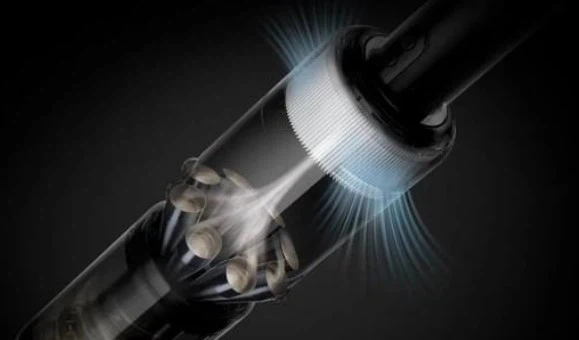
But when the "maximum vacuum (Pa)", the air inlet is completely closed,
At this time, it was like the pearls in the milk tea blocked the straw, and nothing could be sucked up.
In the same way, the maximum vacuum degree of the vacuum cleaner is obtained by testing when the air inlet of the vacuum cleaner is blocked, which is an ideal value with a very large pressure value - but this is obviously unreachable in real-life vacuuming scenarios.
So what about the suction power (AW)? First let's look at this formula -
Suction power = air volume (air velocity, L/s) * pressure (vacuum degree, kPa)
The suction power (AW) is also an important parameter to measure the performance of the vacuum cleaner, which represents the energy of the suction air flow of the vacuum cleaner per unit time. This parameter reflects both the air flow rate and the vacuum degree. Only when the air flow rate and the vacuum degree are large enough, the suction power can reach the maximum value. When we see that the suction power of vacuum cleaners on the market reaches "185AW", the emphasis is on the maximum suction power of the vacuum cleaner.
Therefore, the maximum suction power AW is more like
When drinking pearl milk tea, how much effort can we exert to suck up as many pearls as possible in a fixed unit of time.
Large air volume will make the machine have better suction efficiency and filtering effect, when a balance between air volume and pressure can be achieved, "robustness to restriction can be achieved on the ground with high resistance. )", which is the "strong suction" of the vacuum cleaner. So we also need to be clear that...
The key is the maximum value of the product of the balance between the air volume and the pressure.
Compared with the maximum vacuum (Pa) that can only be achieved under ideal conditions, it is obviously more reasonable and practical to use the maximum suction power (AW) as a measure of suction.
However, in the face of today's increasingly diverse dust composition and complex home environment, is a good vacuum cleaner enough as long as the suction power is high?
3 | A powerful vacuum cleaner = clean suction + lasting suction power
In addition to having sufficient suction power, a powerful vacuum cleaner also needs to have a good design to achieve excellent suction efficiency (pick-up rate) and good dust separation performance on different types of floors or surfaces. That is to say, people can often clearly perceive in use: whether it can be "cleaned by one suction" and efficiently absorb all the dust, large and small, and whether excessive hair or long-term dust accumulation will cause the suction head to become entangled and airway. The problem of clogging is whether the suction of the machine is the same as before after using it for a period of time.
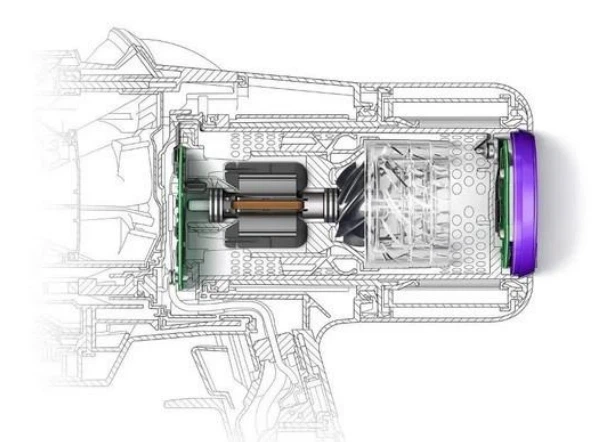
Take Dyson, a well-known vacuum cleaner brand, as an example. At present, Dyson's most powerful [1] Hyperdymium rotary motor can rotate at 125,000 rpm [2]. With the newly designed scroll cyclone, it can provide up to 230AW[1]. 3] suction. In daily use, people can easily absorb the hair on sofas and carpets, dust in crevices and corners, mites in mattresses, and all kinds of dust mites, bacteria, pollen, etc. that are invisible to the naked eye.
The strong suction ensures "clean suction", but it is necessary to ensure that the "suction power is not weakened for a long time [4]" under the diverse scenes and high-demand cleaning needs, and also achieve good dust separation - the motor provides strong energy This is converted into suction without losing the energy needed by the cyclone to separate dust and air. This has to mention Dyson's patented cyclone separation technology. This technology enables more dust particles to be separated and captured by the cyclone before reaching the filter screen, and it is not easy to cause the filter screen to be blocked or bear too much filtration burden, ensuring a lasting and stable suction.
What standards should a good vacuum cleaner have? "Strong suction" is one of the unquestionable ones, but when it comes to people's daily home life, it may also meet more needs and help people create a healthy home from more dimensions surroundings. Therefore, in addition to taking the maximum suction power (AW) as the core parameter when purchasing a vacuum cleaner, the suction efficiency and dust separation performance of the vacuum cleaner should also be taken into consideration, and comprehensive consideration should be made for scientific purchase.


