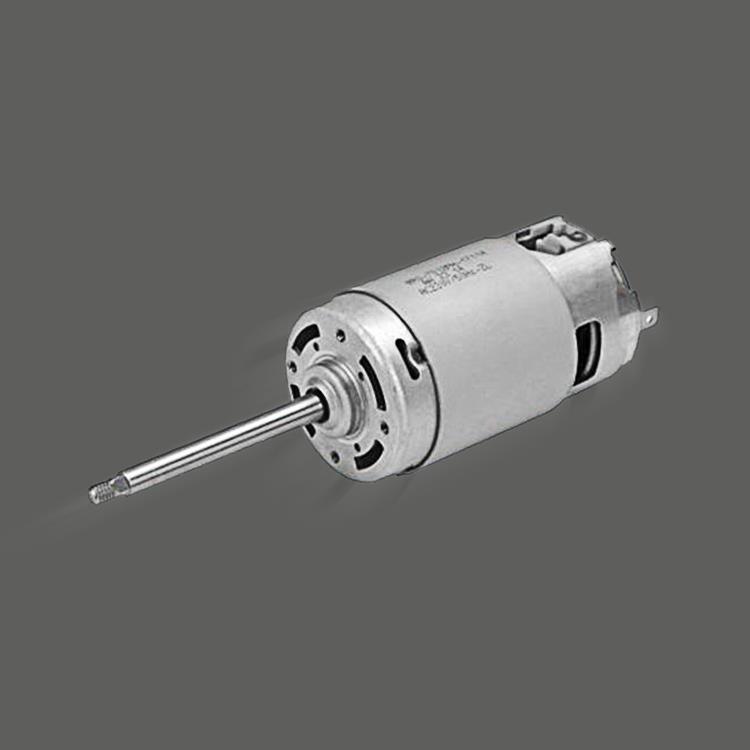
As the name suggests, carbon brushes are made of carbon (that is, graphite, the main component of pencil lead, but some alloys (sheets) instead of graphite carbon brushes). The carbon brush is a component of the brush motor that is placed on the surface of the phase changer. When the motor rotates, the electric energy is transmitted to the coil through the phase converter. Since the main component is carbon, which is called carbon brush, it is easy to wear. Regular replacement should be maintained and the carbon brush should be cleaned.
A carbon brush is a device that transfers energy or signals between a fixed part and a rotating part of an electric motor or generator or other rotating machine. It is generally made of pure carbon plus a coagulant. The outer shape is generally a square, which is stuck on a metal bracket. There is a spring to press it on the rotating shaft. For example, after the oil drilling is completed, it needs to be tested. It is necessary to put the instrument from the wellbore, and the signal is sent from the rotating part (the cable drum of the outer steel wire) to the ground instrument through the carbon brush.
Carbon brush carbon brush [/ url] looks a bit like a pencil eraser with a wire on the top. The volume is large or small.
Carbon brush composition
The carbon brush assembly is composed of a carbon brush holder, a carbon brush, a tension spring and the like. The carbon brush holder is made of FRP material, and the two sides are open, and the left and right sides of the carbon drama pole are embedded in the opening, and the middle is connected by a tension spring, and is appropriately changed. The length of the tension spring makes the pressure of the carbon brush on the slip ring moderate, and can be adjusted to ensure the sensitivity requirement during assembly.
The carbon brush holder plays the role of fixing the carbon brush position in the motor, and the quality of the carbon brush holder directly affects the performance of the motor.
Use of carbon brushes
The role of carbon brushes in the motor:
1. Apply external current (excitation current) to the rotating rotor through the carbon brush (input current)
2. Introduce the static charge on the large shaft into the ground (grounded carbon brush) through the carbon brush (output current)
3. Lead the large shaft (ground) to the protection device for rotor grounding protection and measure the rotor positive and negative ground voltage
4. Change the direction of the current (in the commutator motor, the brush also acts as a commutation)
Except for inductive AC asynchronous motors. Other motors have them, as long as the rotor has a reversing ring.
The principle of power generation is that after the magnetic field cuts the wire, the current is generated on the wire. The generator cuts the wire by rotating the magnetic field. The rotating magnetic field is the rotor and the wire being cut is the stator.
In order for the rotor to generate a magnetic field, a magnetostatic current must be input to the coil of the rotor. The carbon brush is used to send the magnetic current generated by the magnetic generator to the rotor coil.
Only the motor of the commutator or the slip ring has a carbon brush. The ordinary AC asynchronous motor is a squirrel cage structure with no carbon brushes. The motor is the abbreviation of the motor, which is the motor. The motor can be divided into a DC motor and an AC motor. Due to the rotation of the rotor, the DC motor needs to continuously switch the direction of the current according to the position change of the coil in the constant magnetic field, so the coil of the DC motor needs a commutator.
The commutator consists of a brush and a reversing ring, and a carbon brush is a type of brush. Due to the rotation of the rotor, the brush always rubs against the reversing ring, and spark erosion occurs at the moment of commutation, so the brush is a consumable part in the DC motor.
In order to improve the service life, running stability of DC motors and reduce the noise and electromagnetic interference of DC motors, brushless DC motors have gradually replaced the trend of brush motors.
Generally, the AC motor does not use a constant magnetic field, so there is no need for a commutator, and there is no need for a brush; however, the volume of the AC motor is generally large. The motors used in household appliances are generally AC motors. There are no carbon brushes in electric fans, washing machines, refrigerators, air conditioners, etc., but there are also DC motors, such as many electric shavers, kitchen appliances, electric bicycles, etc. The brush is a DC motor (not including brushless). The motors that use dry batteries are all DC motors.
There are two kinds of AC asynchronous motors: the general-purpose starting load of the factory is relatively large, and the winding asynchronous motor has a slip ring, so the electric (carbon) brush (such as lifting, rolling steel motor, etc.), and the light-loaded squirrel cage The induction motor does not have a slip ring, so there is no electricity (carbon) brush (such as electric fan, washing machine, air conditioner, refrigerator, etc.). DC motors have commutators, so use electric (carbon) brushes. The hand drill is generally a DC motor, and the bench drill is an AC asynchronous induction motor; although the general toy and the electric shaver are DC motors, the structure is simple to reduce the cost. The phosphorus-containing elastic brass sheet is used instead. The electric (carbon) brush reversing device is a consumable part of the electric shaver (the wire package inside the motor is generally not bad).