

Universal motors, Induction motors, and DC motors are all electric motors. They are widely used in industry, agriculture and civil fields. Although these electric motors can be used to perform similar jobs, their structures, operating principles, and fields of application are quite different. This article will focus on the differences between Universal motors, Induction motors and DC motors.
1. Universal motor
Series excited motors are also known as AC Universal motors. In a Universal motor, electrical current is sent to both the rotating part (rotor) and the stationary part (stator) of the motor. The relationship between these components can be compared to a series circuit, hence the name universal motor. A universal motor is a speed nonlinear motor. During normal operation, the speed of this motor will gradually decrease as the load increases. Therefore, it is only suitable for low and medium load tasks.
Series motors have two main polarities: positive and negative. When they are connected to DC power, current preferentially flows through the motor rotor and stator. When current flows through the rotor, it creates a magnetic field that interacts with the stator field to create a torque that turns the rotor. The relationship between supply voltage and load and speed can be expressed as the following equation:
Vt=Eb+RpIa
Among them, Vt is the terminal voltage, Eb is the back electromotive force, Rp is the internal resistance of the motor, and Ia is the current of the motor.
Applications of series motors include printing machines, small electrical machinery, industrial exhaust systems, fans, etc.

2. Induction motor
An induction motor is a special type of AC motor. Its rotor is powered by magnetic field induction from the stator's magnetic field. Specifically, the windings on the stator generate an electromagnetic field through the power supply, which rotates and therefore excites an alternating electromotive force. This potential creates eddy currents in the rotor, which in turn create a magnetic field. This rotor field interacts with the stator field, causing the rotor to rotate.
There are different types of induction motors: single-phase induction motors and three-phase induction motors. Three-phase induction motors are more commonly used than single-phase induction motors. Because the rotor of a three-phase induction motor can spin very efficiently. Induction motors have the advantages of low operating cost, strong impeller load capacity, and easy maintenance. These motors are ideal for light to medium duty applications such as fans, pumps, centrifuges, compressors, agitators, etc.

3. DC motor
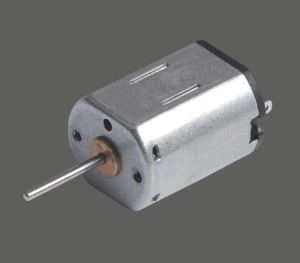
A DC motor is another type of electric motor. Its direction of rotation can be changed by controlling the direction of the DC power supply. There are two types of DC motors: permanent magnet and armature. In a permanent magnet DC motor, the magnetic force creates a naturally permanent magnet material. In an armature DC motor, the magnetic field is generated on the armature by passing a current.
The direction of rotation of a DC motor can be changed by changing the power supply potential. Therefore, it is more flexible than a series motor. Due to its high efficiency and reversibility, DC motors are widely used in many electromechanical equipment, such as electric vehicles, generators, computers, toys and other fields.
In conclusion, Universal motors, Induction motors and DC motors are motors widely used in industrial, agricultural and civil fields. Although they have different structures, working principles and application fields, they all have their own advantages and characteristics. Choosing the right motor will help achieve higher efficiency and better performance.


