


Tamagawa servo motor principle
"Servo" - the word comes from the Greek word "slave". People want to use the "servo mechanism" as a handy tame tool, subject to the requirements of the control signal. Before the signal arrives, the rotor is stationary; after the signal arrives, the rotor rotates immediately; when the signal disappears, the rotor can stop itself. Because of its "servo" performance, it is named the servo system.
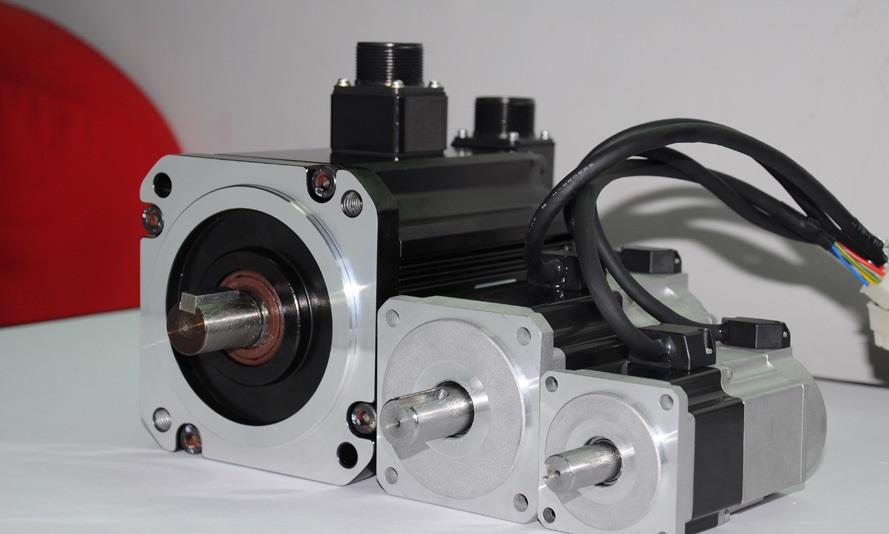
The most common servo is AC permanent magnet synchronous servo motor. The rotor inside the servo motor is a permanent magnet. The stator is a three-phase winding. The driver controls the U/V/W three-phase electric to form a changing electromagnetic field in the stator. The rotor is in this magnetic field. Under the action of the rotation, the encoder feedback signal of the motor is supplied to the driver, and the driver compares the feedback value with the target value to adjust the angle of rotation of the rotor. The accuracy of the servo motor is determined by the accuracy (number of lines) of the encoder. The most common is the servo motor with a 2500 line standard encoder configuration.
Classification of Tamagawa servo motor
A servo motor, also known as an actuator motor, is used as an actuator in an automatic control system to convert an electrical signal received into an angular or angular velocity output on a motor shaft. Divided into two major categories of DC and AC servo motors.
In the AC servo system, the types of motors are permanent magnet synchronous AC servo motor (PMSM) and induction asynchronous AC servo motor (IM). Among them, permanent magnet synchronous motor has excellent low speed performance and can realize weak magnetic high speed control. With a wide speed range, high dynamic characteristics and high efficiency, it has become the mainstream choice for servo systems. Although the asynchronous AC servo motor has a solid structure, simple manufacture, and low price, there is a gap in characteristics and efficiency, and it is only paid attention to in high-power occasions.
The performance of the AC servo system can be measured in terms of speed range, positioning accuracy, steady speed accuracy, dynamic response and operational stability. The mid- and low-end servo system has a speed range of 1:1000 or above, generally 1:3000--1:10000, and the high-performance can reach more than 1:100,000; the positioning accuracy generally needs to reach ±1 pulse, and the speed is accurate. Especially the steady speed accuracy at low speed, for example, given 1 rpm, generally within ±0.1 rpm, the high performance can reach within ±0.01 rpm;
Dynamic response Generally, the servo motor speed takes only a few milliseconds from 0 to the rated speed. In terms of operational stability, it mainly refers to the system voltage fluctuation, load fluctuation, motor parameter change, upper controller output characteristic change, electromagnetic interference, and other specials. The ability to maintain stable operation and guarantee certain performance indicators under operating conditions.


