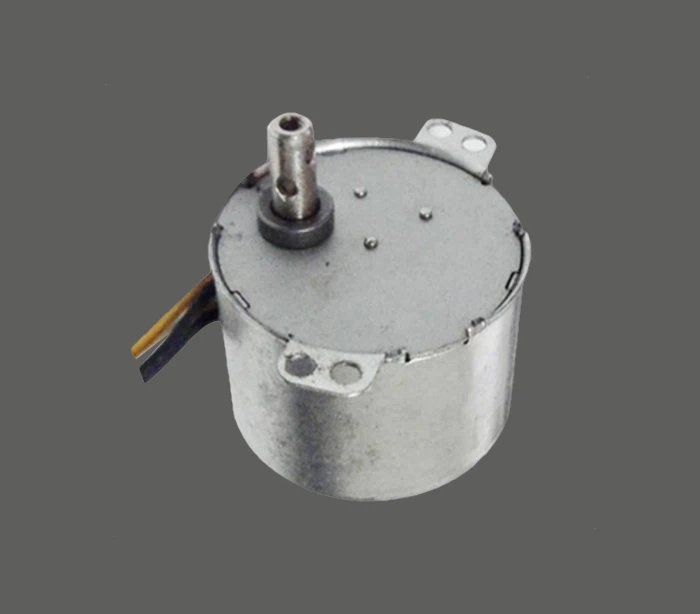
1. Definition of Shaded Pole Motor
Shaded Pole Motor, also known as Shaded Pole Motor, is a type of single-phase AC motor, usually using a cage-type chute cast aluminum rotor.
2. Structure of Shaded Pole Motor
Between rotor groups: It is mainly composed of cast aluminum rotors, shafts, thrust washers to prevent the rotor from moving forward and backward, and gaskets to adjust the amount of movement.
Between stator groups: mainly composed of short-circuit ring and main stator core.
Wire package components: mainly composed of coils, skeletons, lead wires or thermal protectors and related insulating wrapping materials.
Bracket assembly: According to the different installation positions of the shaft extension end and the non-shaft extension end, it is divided into front bracket assembly and rear bracket assembly.
3. Basic Principle of Shaded Pole Motor The stator coil package, that is, after the main winding is powered on, generates a magnetic potential. The magnetic potential enters the air gap through the stator iron core. The action of the ring-secondary winding in the reactance (or Faraday's principle of electromagnetic induction) causes a delayed magnetic potential to enter the air gap, so the two magnetic potential vectors with different phase angles in the air gap magnetic field are superimposed to form a combined magnetic potential. The resultant magnetic potential is a directional rotating magnetic potential. (The direction of rotation of the magnetic potential is always from the unshaded part of the magnetic pole to the shaded part of the pole. Here, it is required to master the method of determining the rotation direction of the motor.) The main magnetic flux generated by the rotating magnetic potential in the magnetic circuit enters the rotor and interacts with the rotor. The squirrel-cage winding is phase-turned, so that a potential is induced in the short-circuited rotor winding, thereby generating a rotor current. The rotor current interacts with the rotating magnetic field in the air gap. According to the left-hand rule, the rotor conductor is stressed, causing the rotor to rotate. This is the most basic electromagnetic process that takes place in shaded-pole motors.
4. Classification of shaded pole motors
Shaded-pole motors are classified into two types: salient-pole shaded-pole motors and recessed-pole shaded-pole motors, according to the different shapes and structures of the stator.
Salient-pole shaded-pole motor: The stator core is a square, rectangular or circular magnetic field frame, the magnetic poles are protruding, and each magnetic pole has one or more short-circuit copper rings that play an auxiliary role, that is, the shaded pole winding. The concentrated winding on the salient pole is used as the main winding.
Concealed-pole shaded-pole motor: The stator core is the same as that of an ordinary single-phase motor. The stator winding adopts distributed winding, and the main winding is distributed in the stator slot. The shaded-pole winding does not need to short-circuit the copper ring, but is wound with thicker enameled wire. The distributed winding (self-short-circuiting after being connected in series) is embedded in the stator slots (about 1/3 of the total number of slots), and plays the role of an auxiliary group. The main winding and the shaded pole winding are spaced apart by a certain angle.
5. Advantages of shaded pole motors
1. The structure is simple, the manufacture is convenient, no additional windings and capacitors are needed, it is suitable for mass production, and the cost is low.
2. Low noise, no radio interference
6. Disadvantages of shaded pole motors
1. The efficiency and power factor are low, and the slip is large.
2. Poor performance and startup.
7. Application scope of shaded pole motor
Generally used for small capacity occasions with no-load or light-load start, such as fans, electric models, etc.