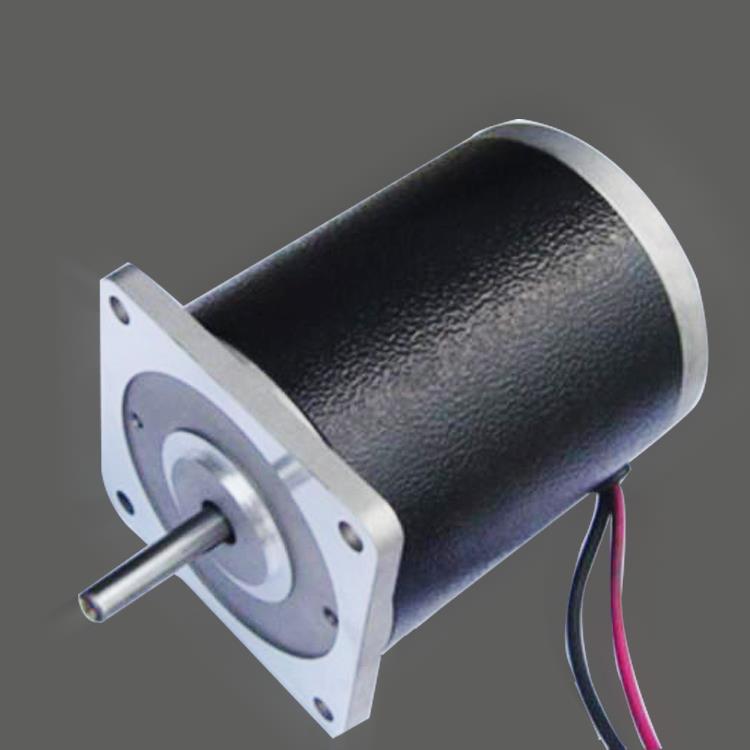
Motor knowledge series DC motor
The working principle of a DC generator is to induce an alternating electromotive force in the armature coil.
By the commutator and the commutation of the brush, it becomes the principle of DC electromotive force when it is taken out from the brush end.
The direction of the induced electromotive force is determined according to the right-hand rule (the magnetic line is pointing to the palm of the hand, the thumb is pointing to the direction of movement of the conductor, and the other four fingers are pointing in the direction of the induced electromotive force in the conductor).
working principle
The direction of the conductor's force is determined by the left-hand rule. This pair of electromagnetic forces forms a moment acting on the armature. This torque is called electromagnetic torque in the rotating machine. The direction of the torque is counterclockwise, in an attempt to rotate the armature counterclockwise. If this electromagnetic torque can overcome the resistive torque on the armature (such as the resistive torque caused by friction and other load torque), the armature can be rotated counterclockwise.
DC motors are motors that operate on DC operating voltage and are widely used in recorders, video recorders, DVD players, electric shavers, hair dryers, electronic watches, toys, etc.
Electromagnetic
The electromagnetic DC motor is composed of a stator magnetic pole, a rotor (an armature), a commutator (commonly referred to as a commutator), a brush, a casing, a bearing, and the like.
The stator magnetic pole (main magnetic pole) of the electromagnetic direct current motor is composed of a core and a field winding. According to the different methods of excitation (the old standard is called excitation), it can be divided into series-excited DC motor, parallel-excited DC motor, separately excited DC motor and compound-excited DC motor. Due to the different excitation modes, the law of the stator magnetic flux (generated by the energization of the excitation coil of the stator pole) is also different.
The excitation winding of the series-excited DC motor is connected in series with the rotor winding through the brush and the commutator. The excitation current is proportional to the armature current. The magnetic flux of the stator increases with the increase of the excitation current. The torque is similar to the electric current. The square of the pivot current is proportional to the speed, which decreases rapidly with increasing torque or current. The starting torque can reach more than 5 times of the rated torque, the short-time overload torque can reach more than 4 times of the rated torque, the speed change rate is large, and the no-load speed is very high (it is generally not allowed to run under no-load) ). Speed regulation can be achieved by connecting (or in parallel) the series windings with external resistors or by switching the series windings in parallel.
The excitation winding of the shunt DC motor is connected in parallel with the rotor winding. The excitation current is relatively constant, the starting torque is proportional to the armature current, and the starting current is about 2.5 times of the rated current. The speed decreases slightly with the increase of current and torque, and the short-time overload torque is 1.5 times of the rated torque. The rate of change of the speed is small, ranging from 5% to 15%. It can be adjusted by weakening the constant power of the magnetic field.
The excitation winding of the DC motor is connected to an independent excitation power supply, and the excitation current is also relatively constant. The starting torque is proportional to the armature current. The speed change is also 5%~15%. The speed can be reduced by weakening the magnetic field constant power or by reducing the voltage of the rotor winding.