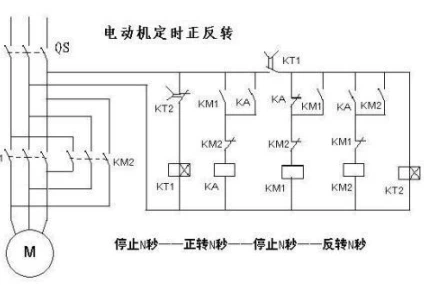
Electric machinery commonly known as "motor", motor (English: Electric machinery, commonly known as "motor") refers to an electromagnetic device that realizes the conversion or transmission of electrical energy according to the law of electromagnetic induction.
The motor is represented by the letter M (the old standard is D) in the circuit. Its main function is to generate driving torque. As a power source for electrical appliances or various machinery, the generator is represented by the letter G in the circuit. The function is to convert mechanical energy into electrical energy.
1. According to the type of working power supply: it can be divided into DC motor and AC motor. 1) DC motors can be divided according to their structure and working principle: brushless DC motors and brushed DC motors. Brushed DC motors can be divided into: permanent magnet DC motors and electromagnetic DC motors. Electromagnetic DC motors are divided into: series-excited DC motors, shunt-excited DC motors, separately-excited DC motors and compound-excited DC motors. Permanent magnet DC motors are divided into: rare earth permanent magnet DC motors, ferrite permanent magnet DC motors and AlNiCo permanent magnet DC motors. 2) Among them, the AC motor can also be divided into: single-phase motor and three-phase motor. 2. According to the structure and working principle, it can be divided into: DC motor, asynchronous motor, synchronous motor. 1) Synchronous motors can be divided into: permanent magnet synchronous motors, reluctance synchronous motors and hysteresis synchronous motors. 2) Asynchronous motors can be divided into: induction motors and AC commutator motors. Induction motors can be divided into three-phase asynchronous motors, single-phase asynchronous motors and shaded-pole asynchronous motors. AC commutator motors can be divided into: single-phase series-excited motors, AC-DC dual-purpose motors and repulsion motors. 3. According to the starting and running mode, it can be divided into: capacitor starting single-phase asynchronous motor, capacitor running single-phase asynchronous motor, capacitor starting running single-phase asynchronous motor and split-phase single-phase asynchronous motor. 4. According to the purpose, it can be divided into: driving motor and control motor.
Motor and electrical control technology, summed up 30 knowledge points for you to understand in seconds,
1. Low-voltage electrical appliances
Refers to electrical appliances that play the role of on-off, protection, control or regulation in circuits with an AC rated voltage of 1200V and a DC rated voltage of 1500V and below.
2. The main electrical appliance
An electrical appliance used to send control commands in an automatic control system.
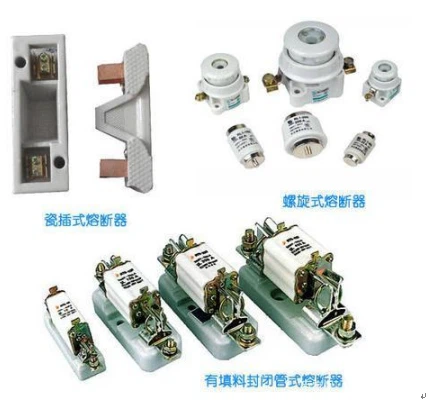
3. Fuse
It is a simple short-circuit or severe overload protection appliance, and its main body is a melt made of low-melting metal wire or metal sheet.
4. Time relay
A control electrical appliance whose contacts are delayed on or off.
5. Electrical schematic diagram
The electrical schematic diagram is a circuit diagram used to represent the connection relationship and working principle of the conductive parts in the electrical components of the circuit.
6. Interlock
An "interlock" circuit is essentially a combination of two inhibiting circuits. The action of K1 prohibits the power of K2, and the action of K2 prohibits the power of K1.
7. Self-locking
The circuit self-locking circuit is the action of using the output signal itself to interlock to maintain the output.
8. Zero voltage protection
In order to prevent the self-starting of the motor when the power supply is restored after the power grid is lost, the protection is called zero-voltage protection.
9. Undervoltage protection
When the power supply voltage drops below the allowable value, in order to prevent the control circuit and the motor from working abnormally, measures need to be taken to cut off the power supply, which is undervoltage protection.
10. Star connection
Three windings, each end connected to one phase of the three-phase voltage and the other end connected together.
11. Triangle connection
The three windings are connected end-to-end, and three-phase voltages are respectively connected to the three connecting ends.
12. Decompression start
When the motor capacity is large, the power supply voltage is lowered and connected to the stator winding of the motor to start the motor.
13. Main circuit
The main circuit is the circuit from the power supply to the motor or the end of the line, and is the circuit through which strong current flows.
14. Auxiliary circuit
Auxiliary circuits are small current-passing circuits.
15. Speed relay
It is a non-electrical signal detection appliance that takes the rotational speed as the input, and it can output a switch signal when the measured rotational speed rises or falls to a predetermined set value.
16. Relay
A relay is a control element that uses changes in various physical quantities to convert electrical or non-electrical signals into electromagnetic force (contact type) or make a step change in output state (contactless type).
17. Thermal relay
It is a protective appliance that works by using the principle of thermal effect of current.
18. AC relay
A relay that draws coil current to AC.
19. Full pressure start
When the motor capacity is small, connect the stator winding of the motor directly to the power supply and start at the rated voltage.
20. Voltage
The potential difference across a circuit.
21. Contacts
Contact, also known as contact, is the executive element of electromagnetic electrical appliances, which plays the role of connecting and breaking the circuit.
22. Electromagnetic structure
The electromagnetic mechanism is the sensing element of electromagnetic electrical appliances, which converts electromagnetic energy into mechanical energy, thereby driving the contacts to move.
23. Arc
The arc is actually a discharge phenomenon caused by the gas between the contacts under the action of a strong electric field.
24. Contactor
Contactor is an automatic control switching appliance suitable for long-distance control and frequent operation of AC and DC main circuits and large-capacity control circuits in low-voltage power distribution systems.
25. Temperature relay
The protective device that uses the overheating element to indirectly reflect the winding temperature and act is called a temperature relay.
26. Jog circuit
Press the jog button, the coil is energized and closed, the main contact is closed, the motor is connected to the three-phase AC power supply, and starts to rotate; release the button, the coil is de-energized and released, the main contact is disconnected, and the motor is de-energized and stopped.
27. Electrical control system
The electrical control system is composed of electrical control components connected according to certain requirements.
28. Pole change speed regulation
In the speed regulation of asynchronous motor, the speed regulation method of changing the number of stator pole pairs.
29.
The electrical component layout diagram is a diagram used to indicate the actual installation position of each component in the electrical principle.
30. Wiring diagram of electrical components
The electrical installation wiring diagram is the specific realization form of the electrical schematic diagram. It is drawn according to the actual position and actual wiring of the electrical components with the prescribed graphic symbols. The working principle of forward, stop and reverse circuit
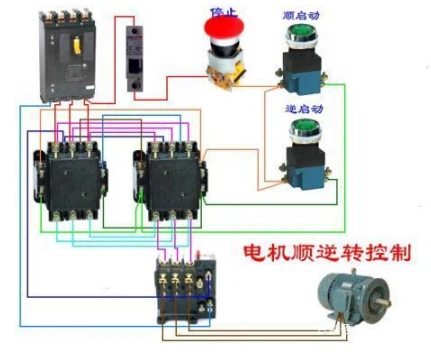
When the forward rotation starts, press the forward rotation start button SB2, the KM1 coil is energized and self-locking, the motor starts and rotates in the forward direction; when the reverse rotation starts, press the reverse rotation start button SB3, the KM2 coil is energized and self-locking , the motor starts in reverse and rotates. In the control circuit, the normally closed auxiliary contacts of the KM1 and KM2 forward and reverse contactors are connected in series with the circuit of the opposite coil to form mutual restriction control. If the forward rotation start button SB2 is pressed, the motor has entered the forward rotation operation. Then, to change the direction of the motor, you must first press the stop button SBl, and then press the reverse start button.