


Stepper Motor Basics
A stepper motor is a motor that rotates a shaft by stepping (i.e. moving it by a fixed angle). Its internal structure means that it does not require a sensor, and the exact angular position of the shaft can be known by simply counting the number of steps. This feature makes it suitable for a variety of applications.
How a stepper motor works
Like all motors, a stepper motor consists of a fixed part (stator) and a moving part (rotor). The stator has gear-like protrusions with coils wound around it, while the rotor is either a permanent magnet or a variable reluctance core. The figure shows a cross-section of a motor with a variable reluctance core.
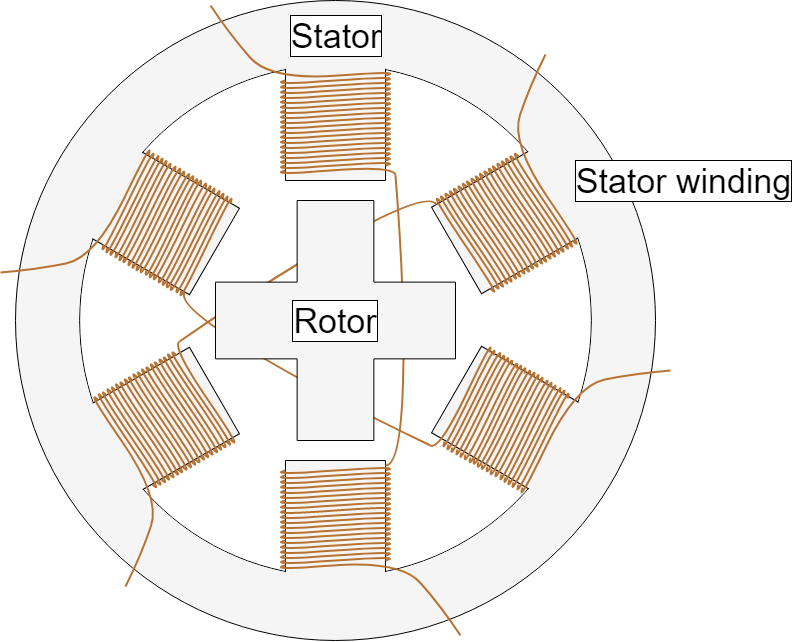
The basic operating principle of a stepper motor is that when one or more stator phases are energized, the current flowing through the coils creates a magnetic field, and the rotor aligns with this field; applying voltage to different phases in turn will cause the rotor to rotate a specific angle and eventually reach the desired position.


