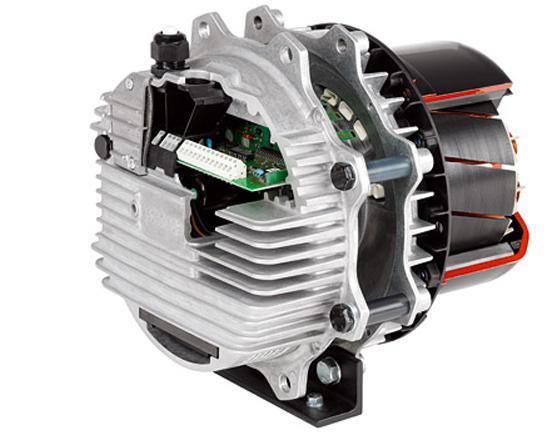
An electronically commutated motor is a brushless DC motor that is controlled by external electronics. The electronic device may be an electronic circuit board or a frequency converter. The implementation of mechanical rectification depends on the electronic circuit. The circuit board can change the phase of the fixed winding to ensure the rotation of the motor and provide an appropriate amount of armature current. Higher accuracy can be achieved if current is delivered in the correct direction over a precise period of time. Since the rotational speed of the electrodes is controlled by external electronic devices, there is no case where the synchronous rectification speed is limited in the electronic rectifying motor.
The electronic rectifying motor has the following advantages: Since this type of motor has no brush, it will not produce Mars or the motor will be shortened due to the brush, and will not waste energy, because it uses electronic devices to control the stator, its performance and controllable Good sex. Compared to induction motors, their operating temperatures are lower. The smaller the motor size, the more space is saved, and even more space is saved when the manufacturer uses the outer rotor.
If an electronically commutated motor is used, the power distribution is also cleaner. The brushless DC motor is driven by a separate DC power supply, and the AC motor's power supply generates additional cost and is more complicated in design. The electronically commutated motor can be directly connected to the AC mains, but it does not depend entirely on voltage or frequency, and small voltage variations do not affect the motor output.
If the electronic rectifying motor is compared with an AC shrouded pole motor or a fixed split capacitor AC motor, it will be found that the efficiency of the shrouded pole motor ranges from 15% to 25%, and the range of the fixed split capacitor AC motor is 30%-50%, while the efficiency of electronically commutated motors ranges from 60% to 75%.
Electronically commutated motors can be used in applications with low power output, such as small fans, servo motors, and motion control technology systems. At present, new methods are being tried to apply this type of motor to high-power output devices such as conveyor belts and condensing units.
In terms of control speed, the electronically commutated motor has multi-speed control function, and the speed controller is its standard accessory. AC motors also offer most control functions and offer an optional external speed controller. The external controller can adjust the primary voltage of the AC motor's transformer, and the sine wave can be changed, which will affect the service life of the motor and increase the noise.
For the electronically commutated motor, the rectifier circuit has a pulse width modulation of 4-20 mA and a voltage of 0-10 V, and the motor speed is controlled within a range of 10% to 100%. The electronic rectifier motor can be monitored by simply using an integrated circuit, and the designer can provide corresponding feedback information. Electronically commutated motors also provide soft start with low noise and motor temperatures.