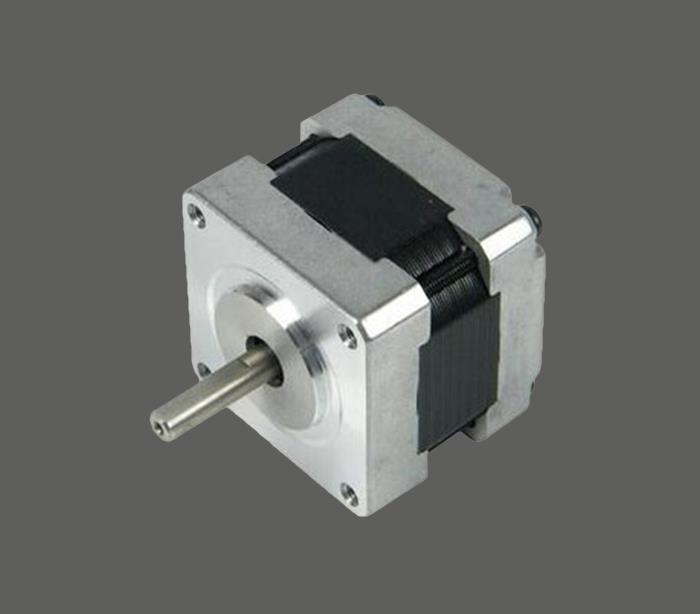
How to classify stepper motors, which ones?
Stepper motors are classified into three types according to the motor structure: permanent magnet (PM), reactive (VR), and hybrid (HB).
Permanent magnet stepping is generally two-phase, torque and volume are small, the step angle is generally 7.5 degrees or 15 degrees; most of them are used in low-cost consumer products.
The reactive stepping is generally three-phase, which can achieve high torque output. The step angle is generally 1.5 degrees, but the noise and vibration are very large. Developed in Europe and the United States in the 1980s has been eliminated;
Hybrid stepping refers to the advantage of mixing the permanent magnet and the reaction type. It is further divided into two phases, three phases and five phases: the two phase step angle is generally 1.8 degrees, the three phase step angle is 0.9 degrees, and the five phase step angle is generally 0.72 degrees. Hybrid stepping is the most common motor for industrial motion control applications.
In addition, according to the motor drive architecture, it can be divided into unipolar and bipolar stepper motors.
The unipolar drive circuit uses four transistors to drive the two phases of the stepper motor. The motor structure includes two sets of coils with intermediate taps as shown in Figure 1. The entire motor has six wires connected to the outside world. This type of motor is sometimes referred to as a four-phase motor, but this designation is confusing and incorrect because it has only two phases, and the exact term should be a two-phase six-wire stepper motor. Although the six-wire stepper motor is also called a unipolar stepper motor, it can actually use a unipolar or bipolar drive circuit at the same time.
The driving circuit of the bipolar stepper motor is shown in Figure 2. It uses eight transistors to drive the two phases. The bipolar drive circuit can drive a four-wire or six-wire stepper motor at the same time. Although the four-wire motor can only use a bipolar drive circuit, it can significantly reduce the cost of mass production applications. The number of transistors in a bipolar stepper motor drive circuit is twice that of a unipolar driver circuit. Four of the lower transistors are usually driven directly by the microcontroller, and the upper transistors require a higher cost upper driver circuit. The transistor of the bipolar drive circuit only needs to withstand the motor voltage, so it does not require a clamp circuit like a unipolar drive circuit.