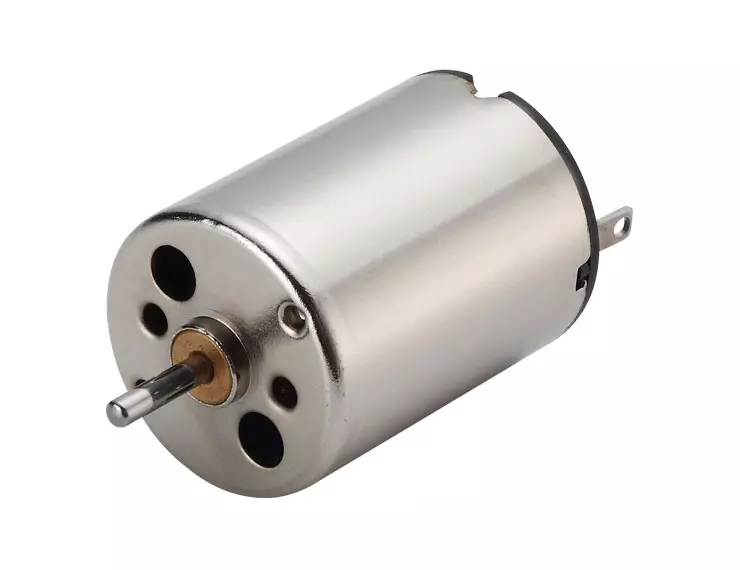
As an important and indispensable power provider in people's production and life, many motors will have serious heating during use, but many times they don't know how to solve it. What's more serious is that they don't know what causes the motor to heat up. This should be the first thing to master during the use of the motor. Let's take a look at the common reasons why the motor heats up very seriously.
1. The air gap between the stator and rotor of the motor is very small, which easily leads to collision between the stator and rotor.
In medium and small motors, the air gap is generally 0.2mm~1.5mm. When the air gap is large, the excitation current is required to be large, which affects the power factor of the motor; if the air gap is too small, the rotor may rub or collide. Generally, due to the serious tolerance of the bearing and the wear and deformation of the inner hole of the end cover, the base, end cover, and rotor are not in the same axis, causing the bore to be swept, which can easily cause the motor to heat up or even burn. If the bearing is found to be worn, it should be replaced in time, and the end cover should be replaced or brush-plated. A relatively simple treatment method is to insert a sleeve for the end cover.
2. Abnormal vibration or noise of the motor can easily cause the motor to heat up. This situation is caused by the motor itself. Most of them are caused by poor dynamic balance of the rotor, poor bearing, bent shaft, different axis of the end cover, base, and rotor, loose fasteners, uneven foundation of the motor installation, and improper installation. It may also be transmitted from the mechanical end, which should be eliminated according to the specific situation.
3. Abnormal bearing operation will definitely cause motor heating. Whether the bearing is working properly can be judged by hearing and temperature experience. You can use your hand or a thermometer to detect the bearing end to determine whether its temperature is within the normal range; you can also use a listening stick (copper stick) to touch the bearing box. If you hear an impact sound, it means that one or several balls may be crushed. If you hear a hissing sound, it means that the bearing is not lubricating enough. The motor should be replaced with grease every 3,000 to 5,000 hours.
4. The power supply voltage is too high, the excitation current increases, and the motor will overheat. Excessive voltage will endanger the insulation of the motor and put it in danger of breakdown. When the power supply voltage is too low, the electromagnetic torque will decrease. If the load torque does not decrease and the rotor speed is too low, the increased slip rate will cause the motor to overload and heat up. Long-term overload will affect the life of the motor. When the three-phase voltage is asymmetric, that is, when one phase voltage is high or low, it will cause a phase current to be too large, the motor to heat up, and the torque reduction will make a "buzzing" sound, which will damage the winding over time.
In short, whether the voltage is too high, too low or asymmetric, the current will increase, the motor will heat up and damage the motor. Therefore, according to national standards, the change of the motor power supply voltage should not exceed ±5% of the rated value, and the motor output power can maintain the rated value. The motor power supply voltage is not allowed to exceed ±10% of the rated value, and the difference between the three-phase power supply voltages should not exceed ±5% of the rated value.