


Design and Analysis of High Speed Permanent Magnet Motor
This paper designs and analyzes a 130kW high speed permanent magnet motor for air compressors with a speed of 31,500rpm. For the design specifications of high-speed motors, the motor materials are selected and the magnetic circuit method is used to calculate the various dimensions of the motor. The finite element software is used to analyze the electromagnetic field of the designed motor and analyze the stator and rotor losses of the motor. Then, by analyzing the motor sheath material and the permanent magnet magnetization method, the purpose of reducing the internal loss of the motor, lowering the temperature, and improving the performance of the motor can be achieved.
Analysis of Electromagnetic Field of High Speed Permanent Magnet Synchronous Motor
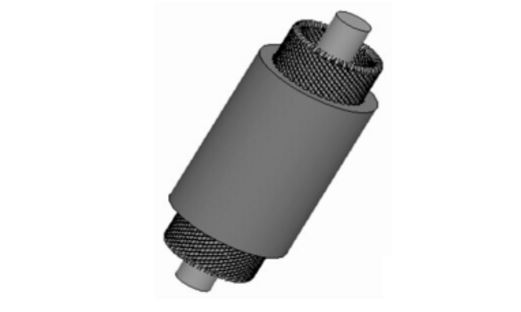
The three-dimensional model of a high-speed permanent magnet synchronous motor for a gas compressor is shown in Fig. 1. The magnetic flux distribution network generated by the permanent magnets of the South Motor is shown in Figure 2. The magnetic field lines of the permanent magnets are shown in Figure 3.

It can be seen from Fig. 2 that the magnetic field lines of the permanent magnet synchronous motor are generated by permanent magnets, and the flow paths of the magnetic lines of force are stator teeth, stator yokes, stator teeth, air gaps, stator yokes, stator teeth, and the magnetic flux density in the stator yoke is obvious. Greater than the magnetic density in the coil. It can be seen from the above figure that the distribution and direction of the magnetic flux of the permanent magnet motor are reasonable, the leakage flux is relatively small, the magnetic flux leakage coefficient is small, and the utilization rate of the permanent magnet is high, which meets the motor design requirements.

The arrow in Fig. 3 is the direction of the flow of the magnetic lines of force. It can be seen from the above figure that the magnetic lines of force in the motor are generated by the permanent magnets, flow through the stator teeth, the stator yoke and the air gap, and finally return to the stator teeth, forming a closed loop. In line with the actual theory.


