

7 asynchronous motor
First, AC asynchronous motor
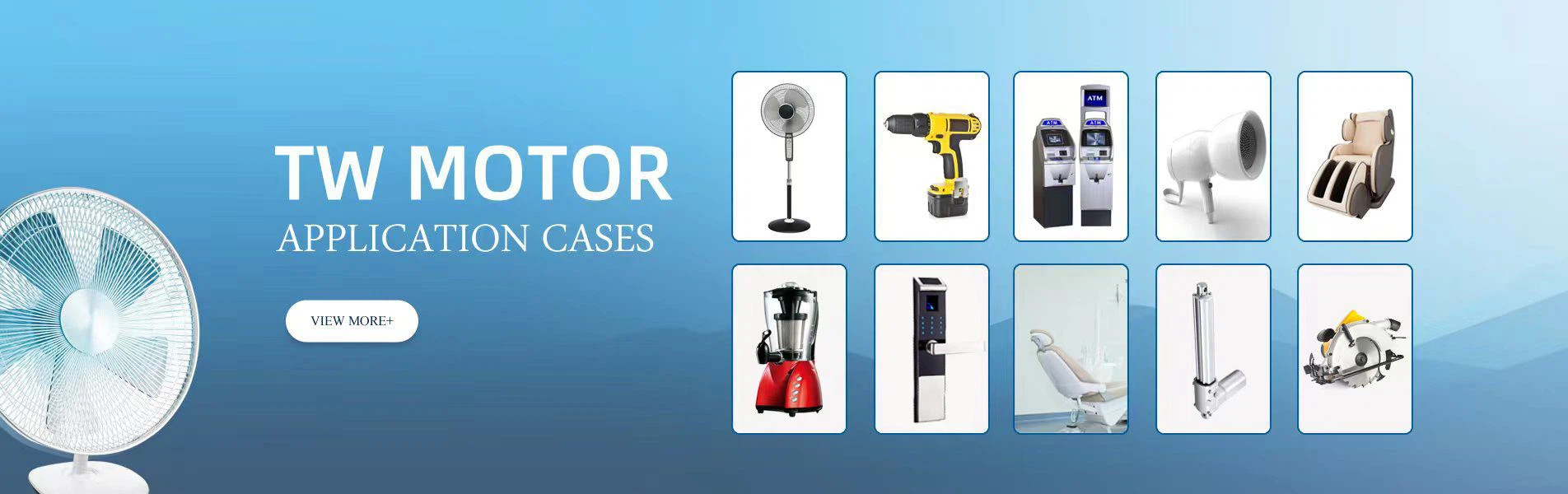
AC asynchronous motor is the leading AC voltage motor, widely used in electric fans, refrigerators, washing machines, air conditioners, hair dryers, vacuum cleaners, range hoods, dishwashers, electric sewing machines, food processing machines and other household appliances and various electric Tools, small electromechanical equipment.
The AC asynchronous motor is divided into an induction motor and an AC commutator motor. The induction motor is further divided into a single-phase asynchronous motor, an AC-DC motor, and a repeller motor.
The speed of the motor (rotor speed) is less than the speed of the rotating magnetic field, so it is called an asynchronous motor. It is basically the same as the induction motor. s = (ns - n) / ns. s is the slip rate,
Ns is the magnetic field speed and n is the rotor speed.
Fundamental:
1. When the three-phase asynchronous motor is connected to the three-phase AC power supply, the three-phase stator winding flows through the three-phase magnetomotive force generated by the three-phase symmetrical current (stator rotational magnetomotive force) and generates a rotating magnetic field.
2. The rotating magnetic field has a relative cutting motion with the rotor conductor. According to the principle of electromagnetic induction, the rotor conductor generates an induced electromotive force and generates an induced current.
3. According to the law of electromagnetic force, the current-carrying rotor conductor is subjected to electromagnetic force in the magnetic field to form electromagnetic torque, which drives the rotor to rotate. When the motor shaft has a mechanical load, it outputs mechanical energy outward.
An asynchronous motor is an AC motor whose ratio of the speed of the load to the frequency of the connected grid is not constant. It also changes with the size of the load. The greater the load torque, the lower the rotor speed. Asynchronous motors include induction motors, doubly-fed induction motors, and AC commutator motors. Induction motors are the most widely used, and in general, induction motors are asynchronous motors without causing misunderstanding or confusion.
The stator winding of a common asynchronous motor is connected to the AC grid, and the rotor winding does not need to be connected to other power sources. Therefore, it has the advantages of simple structure, convenient manufacture, use and maintenance, reliable operation, low quality and low cost. Asynchronous motors have higher operating efficiency and better working characteristics, and they are close to constant speed operation from no-load to full-load range, which can meet the transmission requirements of most industrial and agricultural production machinery. Asynchronous motors are also easy to generate various protection patterns to suit different environmental conditions. When the asynchronous motor is running, the reactive power must be drawn from the grid to make the power factor of the grid deteriorate. Therefore, synchronous motors are often used for driving high-power, low-speed mechanical equipment such as ball mills and compressors. Since the speed of the asynchronous motor has a certain difference in rotational speed with the rotating magnetic field, the speed regulation performance is poor (except for the AC commutator motor). It is economical and convenient to use DC motors for transportation machinery, rolling mills, large machine tools, printing and dyeing and papermaking machinery that require a wide and smooth speed range. However, with the development of high-power electronic devices and AC speed control systems, the speed regulation performance and economy of asynchronous motors suitable for wide speed regulation are comparable to those of DC motors.
Second, single-phase asynchronous motor
The single-phase asynchronous motor is composed of a stator, a rotor, a bearing, a casing, an end cover and the like.
The stator consists of a base and a core with windings. The iron core is formed by laminating silicon steel sheets, and two sets of main windings (also called running windings) and auxiliary windings (also called starting windings into secondary windings) with 90° electrical angles are embedded in the slots. The main winding is connected to the AC power supply, and the auxiliary winding is connected to the centrifugal switch S or the starting capacitor, the running capacitor, etc., and then connected to the power supply.
The rotor is a cage-cast aluminum rotor, which is formed by laminating iron cores and casting them into the core of the iron core, and casting the end rings together to short-circuit the rotor bars into a squirrel cage type.
The single-phase asynchronous motor is further divided into a single-phase resistance starting asynchronous motor, a single-phase capacitor starting asynchronous motor, a single-phase capacitor running asynchronous motor, and a single-phase two-value capacitor asynchronous motor.
Three-phase asynchronous motor
The structure of the three-phase asynchronous motor is similar to that of the single-phase asynchronous motor, and the three-phase windings are embedded in the stator core slot (the three-layer chain type, the single-layer concentric type and the single-layer cross type). After the stator winding is connected to the three-phase AC power supply, the rotating magnetic field generated by the winding current generates an induced current in the rotor conductor, and the rotor generates an electromagnetic transfer cabinet (ie, an asynchronous transfer cabinet) under the interaction of the induced current and the rotating magnetic field of the air gap. To rotate the motor.
Fourth, the cover pole motor
The shaded pole motor is the simplest one of the one-way AC motors, usually a caged chute cast aluminum rotor. According to the different shape structure of the stator, it is also divided into a salient pole type pole motor hidden pole type pole motor.
The stator core of the salient pole-shielded motor has a square, rectangular or circular magnetic field frame, and the magnetic poles are convex. Each magnetic pole has one or more auxiliary short-circuiting copper rings, that is, a shrouded pole winding. The concentrated winding on the salient pole is used as the main winding.
The stator core of the hidden pole-shielded motor is the same as that of the ordinary single-phase motor. The stator winding adopts distributed winding, and the main winding is distributed in the stator slot. The shaded winding does not need to short-circuit the copper ring, but is wound with a thick enameled wire. The distributed windings (self-shorted after series connection) are embedded in the stator slots (about 2/3 of the total number of slots) and function as auxiliary groups. The main winding and the shrouded pole winding are at a certain angle from each other in space.
When the main winding of the shaded pole motor is energized, the shrouded pole winding also generates an induced current, causing the stator pole to be rotated in the direction of the covered portion by the portion of the magnetic flux and the unshielded portion of the shrouded pole winding.
Five, single-phase series excitation motor
The stator of the single-phase series-excited motor is composed of a salient pole core and a field winding, and the rotor is composed of a hidden pole core, an armature winding, a commutator and a rotating shaft. A series circuit is formed between the field winding and the armature winding through a brush and a commutator.
The single-phase series-excited motor is an AC and DC motor. It can work with AC power or DC power.


