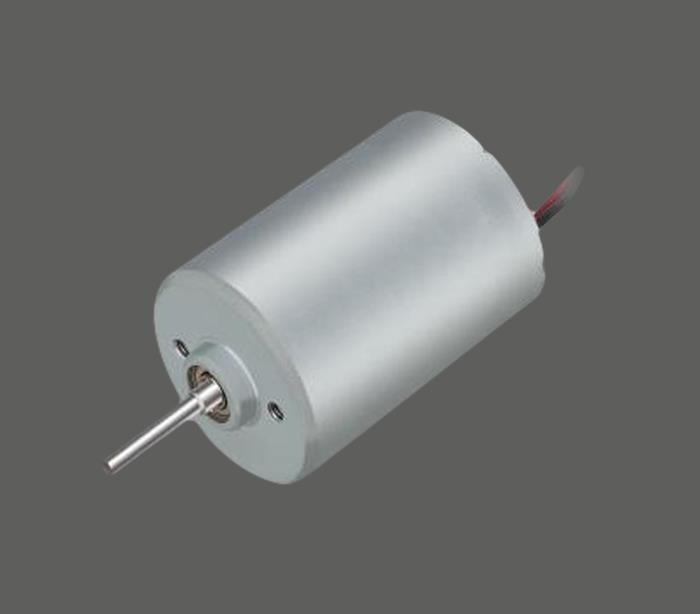
Application scheme of brushless motor on fan motor
Because the brushless DC motor has no excitation winding, no commutator, no brush, no slip ring, its structure is simpler than the traditional AC and DC motors, the operation is more reliable, and the maintenance is relatively simple. Compared with the squirrel-cage induction motor, the simplicity of its structure and the reliability of operation are roughly equivalent. Since there is no magnet consumption and copper consumption, the power is 10%~20% higher than that of the current-excited motor of the same specification when the power is below 300W; it is more efficient than the induction motor.
The brushless DC motor is generally driven by a square wave, and the Hall sensor is used to obtain the rotor position. The signal is forced to commutate by this signal. This scheme has a simple control method and low cost, and is widely used in the current electric vehicle scheme. When there is a sudden change in current, the torque ripple is large, so the noise index is poor, which is difficult to promote in the field of home appliance applications. The sinusoidal drive can avoid sudden changes in current during commutation, although the maximum torque will decrease, but on the noise index. There are obvious advantages.
Usually, the control of the permanent magnet synchronous motor http://bbsic.big-bit.com/ uses DSP, and the motor needs to provide an optical encoder disk to accurately detect the rotor position, which can realize high-precision control and even be used in the servo system, but The cost will be very high, home appliance application is very sensitive to price, and some applications have low performance requirements. For example, electric fan, traditional DSP vector control sinusoidal drive high cost solution is also difficult to promote. Therefore, this paper proposes to use 8-bit microcontroller integrated PWM. The sinusoidal drive scheme of the generator has a high market value.
Generally, the air-gap magnetic field of a sinusoidal drive DC brushless motor is a sine wave (also called a permanent magnet synchronous motor) or a magnetic field waveform after a sine wave is injected into a higher harmonic. The stator uses a distributed winding, so the back electromotive force is also a sine wave. The three-way Hall sensor is mounted on the rotor, and the output changes every 60° electrical angle as a synchronization signal of the sine wave, ensuring no cumulative error.
Second, the hardware structure
The core of this solution is an 8-bit single-chip microcomputer SH79F168 with integrated PWM generator. It adopts optimized single-machine cycle 8051 core, built-in 16kFlash memory, compatible with all hardware resources of traditional 8051, adopts JTAG emulation mode, built-in 16.6MHz oscillator, and expands at the same time. The following functions:
Dual DPTR pointers. 16-bit x8 multiplier and 16-bit/8 divider.
3 channel 12-bit with dead zone control PWM, 6 outputs, output polarity can be set, center and edge alignment mode
Integrated fault detection function, which can instantly turn off the PWM output.
Built-in amplifier and comparator for current amplification sampling and overcurrent protection.
Provide hardware anti-jamming measures.
Provide Flash self-programming function, can be used as EEROM for simulation, convenient to store parameters.
The main system architecture adopts three-phase full-control bridge, bootstrap boost driver IC, control ground and power sharing, adopts IC built-in amplifier and ADC to realize current and voltage sampling, saves voltage/current transformer, and utilizes integrated comparator inside IC. And PWM fault detection function to achieve overcurrent protection.